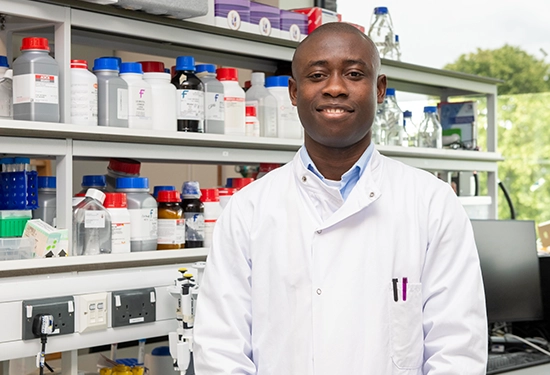
 Dr. Joshua N. Awoke, Associate Fellow of the Higher Education Academy (AFHEA), is the fourth recipient of the J. Andrew McKee Fellowship in Type 1 Diabetes (T1D), jointly funded by Breakthrough T1D Canada and the Stem Cell Network (SCN) based at the Breakthrough T1D Centre of Excellence at the University of British Columbia (UBC).
The J. Andrew McKee Fellowship in Type 1 Diabetes was developed to accelerate Canadian research, develop talent and augment Canada’s global leadership in T1D research. The Fellowship Program is named in honour and memory of John Andrew McKee, who was Past President and CEO at Breakthrough T1D (then known as JDRF) and a long-standing member and Chair of SCN’s Board of Directors. Andrew played a significant role in developing the future of both organizations and believed deeply in the important role of science in making Canada a better place for all.
Dr. Awoke will be joining the Breakthrough T1D Centre of Excellence from Nottingham Trent University (United Kingdom) where he was a PhD Researcher in Biomedical Science with focus on developing new therapeutics for metabolic diseases and their complications.
Dr. Awoke will be researching islet prohormones as biomarkers of disease prediction and response to immuno-and cell therapy, which has the potential to impact clinical practice and improve T1D prediction and treatment.
Dr. Awoke took some time out of his very busy schedule to discuss his research and what he hopes to accomplish through the Fellowship.
Tell us a bit about your background:
I completed my BSc in biochemistry at Ebonyi State University (Nigeria). This offered me an excellent background knowledge on the molecular basis of disease development. Then, I went to the University of Aberdeen (Scotland), for my MSc in clinical pharmacology, where I engaged in studies related to obesity and diabetes for my research project.
Both degrees created the much-needed scientific curiosity and passion to engage in more in-depth studies to understand the molecular basis of obesity and diabetes. Then, I did my PhD in biomedical science at Nottingham Trent University, where I investigated the anti-inflammatory actions of carnosine in metabolic diseases.
I am now taking up postdoctoral training at Breakthrough T1D Centre of Excellence, UBC, where I will investigate islet prohormones as potential biomarkers of T1D prediction and response to immuno-and cell therapy. I am hopeful this will contribute positively to clinical practice and improvement in T1D, prediction, prognosis, and management.
What made you apply for this Fellowship?
As my PhD research was winding down, I was gearing up to move forward to the next phase of my career development, which is postdoctoral research training. More to this is that my MSc and PhD degrees were all done in the UK, so, I wanted to go elsewhere, like Canada, which is also a global leader in diabetes research. Therefore, I looked out for postdoctoral fellowships in Canada in the field of diabetes research like the J. Andrew McKee Fellowship in Type 1 Diabetes. This prestigious fellowship is open for young talented early career researchers like me from anywhere in the world to come to Canada and contribute to Canada’s global leadership in T1D research.
So, I believed it was the ideal fellowship for me, and which will spark my dynamic career progression in T1D research in addition to my overall career goals and aspiration of becoming an independent researcher and a PI in the future.
What drew you to type 1 diabetes as a research field?
Sadly, I had a lovely foster sister who passed away as a teenager due to T1D. Growing up, I could still remember how she solely depended on insulin administration and how crucial the situation was anytime her supply of insulin was exhausted.
This sparked my interest, curiosity, and passion to know more about T1D. I also know other families and friends in my community who live with T1D and the enormous burden of the disease on them. I therefore thought that if someone could discover insulin that has continued to help millions of lives globally, then maybe I could help save additional lives through my research in T1D. So, I believe my research could bring great relief to those families with T1D and increase their quality of life. I know that perhaps seems too ambitious, but where there is a will, there is a way.
Tell us more about the research you will be conducting at the Breakthrough T1D Centre of Excellence at UBC?
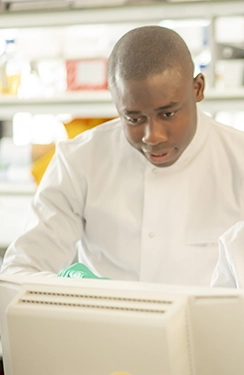 My research at UBC will focus on the islet prohormones as biomarkers of T1D prediction, prognosis, and response to immuno- and cell therapy. Firstly, insulin and islet amyloid polypeptide (IAPP) are the key hormones produced by islet beta cells.
These hormones are implicated in T1D due to their key roles in regulation of glucose metabolism and homeostasis. Interestingly, they are first produced as precursor peptides known as proinsulin and proIAPP. However, only healthy and differentiated beta cells can properly process these precursors to their fully mature and active forms. Incompletely processed proinsulin and proIAPP may therefore correlate with beta-cell dysfunction in T1D and may also be useful in predicting progression to T1D, response to immunotherapy, and beta-cell transplant failure.
So, I will utilize several advanced techniques at the Breakthrough T1D Centre of Excellence at UBC to discover, validate, and assess these prohormones in diverse lab/clinical T1D models. The overall goal is to utilize them as effective biomarkers to improve T1D prediction and prognosis, which will positively impact clinical practice in T1D treatment and management.
How is the Breakthrough T1D-SCN fellowship going to advance this research?
This fellowship is so amazing and all-encompassing. I like the fact that it is tailored towards both the training of the Fellow and doing the actual research.
I will primarily be supervised by Dr Bruce Verchere whose lab has already shown strong preliminary evidence that some forms of incompletely processed proIAPP and proinsulin are disproportionately elevated in persons with T1D as well as in recipients of islet transplants prior to graft failure.
So, this fellowship will provide the needed resources to investigate these prohormones on more diverse and larger scale lab/clinical models, which have not been done before. Another fantastic aspect is that through the framework of this fellowship, we will also collaborate with other Breakthrough T1D Centre of Excellence labs in stem cell differentiation and beta-cell function assessment to effectively realize the overall goal of this project.
What are you most excited about with your move from the UK to Vancouver?
Firstly, UBC is within the top tier universities known for research excellence in various fields globally. They are also renowned for various research breakthroughs in diabetes both in Canada and globally. So, I am super excited to begin my postdoctoral training at such a world-class university known for research excellence as I believe it will have a huge impact on my career advancement.
Then, I really love the natural beauty of coastal areas and the beautiful mountain views in Vancouver. So, I can’t wait to enjoy the adventures of looking and walking through these amazing natural wonders outside my lab/work hours in Vancouver. Finally, I have learnt from my friend that Vancouver is a very diverse and inclusive cosmopolitan city with different ethnic nationalities. Therefore, it will be amazing to meet and work with people from diverse multicultural backgrounds in Vancouver.
***
Breakthrough T1D Canada is grateful to Dr. Awoke for his time and congratulates him on the fellowship award. Thank you, Dr. Awoke for contributing to critical cure-based T1D research and further strengthening Canada as a global leader in this field.