What does a cure for type 1 diabetes (T1D) look like?
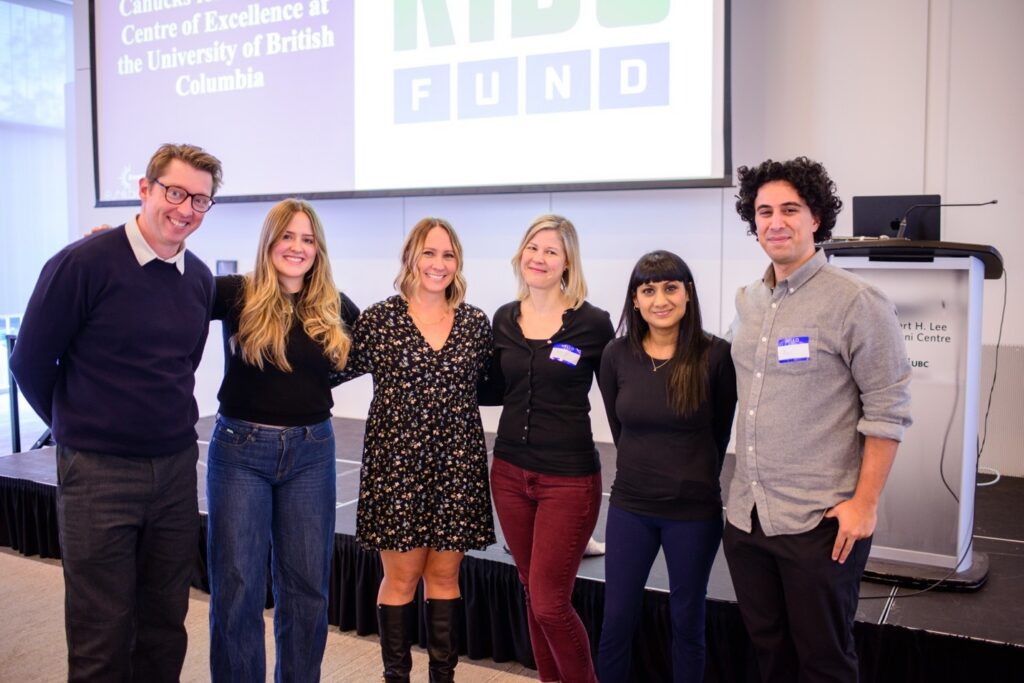
Authors: Katie Bartel, Beth Miller, Tony Lucas, Benjamin Mammon, for The Breakthrough T1D Canucks For Kids Fund Centre of Excellence at UBC T1D Lived Advisory Group
That was the question that the Type 1 Diabetes Lived Experience Advisory Group attempted to answer through a recent anonymous survey.
The group quickly learned it’s not an easy puzzle to solve.
The Breakthrough T1D Canucks For Kids Fund Centre of Excellence at UBC T1D Lived Advisory Group has a key role at Centre outreach events and enabling dialogue between researchers and people living with T1D. The recent survey was done to gather information to inform these discussions and, in turn, the Centre’s cure-focused research program.
Of the 49 respondents, there were varying degrees of what a cure for T1D looks like – some want fully functioning insulin production, whereas others would be satisfied with a device-free lifestyle. Some respondents focused more on improved quality of life, while others struggled to put any kind of description to a T1D cure.
“Type 1 requires so much decision making on a daily basis that I cannot help but wonder what my brain will do with that space and time,” one participant commented. “Am I less likely to face decision fatigue? More likely to have more resilience to frustration… the potential is significant, but the ability to guess what that might be is difficult.”
It’s these types of responses that the Centre’s T1D Advisory Group believes is essential for researchers to know.
“If we don’t know what a cure looks like for people with type 1 diabetes, we can’t work towards it,” said Dr. Søs Skovsø, scientific project coordinator at the Centre, and Chair of the Advisory Group.
And that’s where the Advisory Group plays a role.
The Advisory Group is made up of eight members who either live with T1D or care for people living with T1D. The group’s objective is to integrate the voices of people with T1D into T1D research.
The Advisory Group developed a survey that was distributed through local T1D community networks and stayed open for one month. There were 49 respondents in total; 33% were caregivers and 67% lived with T1D. Most respondents lived in Canada – 53% in BC and 41% in other provinces. The remaining 6% lived internationally.
The main query of the survey was “What does a cure for T1D mean for you?”
Questions included rating the importance of restoring the body’s ability to produce its own insulin again, versus preventing the immune system from attacking insulin-producing cells. The survey asked about the importance of a cure being device free, as well as the significance of improvements to quality of life gained with the introduction of a cure.
51% of survey respondents responded that a cure involving stem cell therapy would be extremely important; 58% rated immune therapy as extremely important; and 40% rated being device-free as extremely important. And when asked about the most important benefit that a T1D cure could provide – improved mental health was rated higher than freedom from blood sugar checks, elimination of insulin dependence, and reduction of long-term health risks.
The question that was most surprising for Advisory Group members and researchers at the Centre was how confident respondents were that a cure would be found in their lifetime.
Responses varied: some were confident, others skeptical.
“The mixed response from the community doesn’t reflect the exciting work that’s going on at the Centre,” said Advisory Group member Beth Miller. “This highlights a need for better communication between the scientific community and the broader T1D community,” Miller added.
Skovsø agrees.
“Some people have lost hope for a cure, and at the same time others thinking that there’s a cure coming next year,” she said. “This means that the research community has to do a better job at communicating that a cure may not be available next year, but it is within reach.”
The Advisory Group’s survey is the first of its kind according to Dr. Bruce Verchere, one of the lead principal investigators at the Centre.
“This survey promises to increase the impact of T1D research in the Centre by helping researchers better understand the hopes and expectations of persons living with T1D, and how research could improve their lives,” said Verchere.
“What a cure looks like to a parent of a child with T1D, or to someone living with T1D for 30 years, or to a scientist is going to be different,” said Skovsø. “Hopefully this survey will help open minds that a cure is not single-sided; it’s multi-faceted.”
This survey was just the first step. A second quantitative survey is now being developed by the Advisory Group, in collaboration with the Centre research team, with the intent of reaching a wider audience and publishing the results in a scientific journal.
“It’s cool to see the work and conversations coming out of the Advisory Group trickle and spread into the science community,” said Skovsø. By publishing a larger study, “we can spark even more conversation and understanding.”