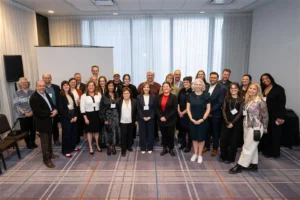
On Nov 3-6, 2025, Montreal was host to the International Society for Pediatric and Adolescent Diabetes (ISPAD) 51st Annual Conference. ISPAD is a yearly highlight of the T1D conference calendar, and this year was no exception. Scientists, clinicians, researchers, industry members, people with diabetes, and more were on hand to provide updates in cures, improving lives, access, and more—with much of it being supported by Breakthrough T1D.
ISPAD co-Presidents Drs. Melanie Henderson (CHU Sainte-Justine and Université de Montréal) and Julia E. von Oettingen (McGill University) welcomed the international diabetes community to Montreal, highlighting the city’s deep commitment to pediatric diabetes care and research.
Early detection of T1D
Several researchers presentedcountry-level results from T1D screening pilots and programs across multiple sessions. Early detection of T1D can provide opportunities for education to avoid diabetic ketoacidosis at diagnosis, time to prepare for insulin therapy, and immunotherapy to delay disease onset. A Canadian expert in this area, Dr. Diane Wherrett (SickKids Hospital. Toronto) was this year’s W!LD ISPAD honoree for her dedication to pediatric endocrinology, T1D prevention research, and leadership of the CanScreen T1D consortium.
Disease-modifying therapies
Disease-modifying therapies address the underlying cause of T1D, meaning that they protect beta cells, stop the autoimmune attack, or both. The University of Alberta’s Dr. Alice Carr provided ag talk about the roadmap for precision medicine in disease-modifying therapies for T1D, emphasizing the need for more precise measures of beta cell function in early-stage disease and highlighting the importance of including perspectives of people with T1D into every stage of the research process.
Interim results were also presented from Sanofi’s PETITE-T1D trial testing the efficacy and safety of Tzield in kids aged 0-7 with early-stage T1D. Tzield is currently approved for children and adults aged eight and older with stage 2 T1D, in whom it can delay the onset of stage 3 T1D by an average of 3 years. The new results show that the safety profile of Tzield in children under the age of 8 is similar to that of older individuals who receive the drug. This study is ongoing and we look forward to seeing more data.
SAB BIO presented compelling data about humanized anti-thymocyte globulin (ATG), which holds promise to delay the onset and progression of T1D. Recent results showed that animal-derived ATG holds promise for this purpose, and therefore this humanized version of the drug (which is likely to have fewer side effects) is an exciting development.
Technology improves outcomes
A common theme throughout multiple presentations about diabetes devices is that automated insulin delivery (AID) systems help people do better. This spans several different technologies and systems: Tandem Control IQ, Minimed 780G, Cam APS (Ypsomed pump), and OmniPod. Here’s why:
The near-constant adjustments made by these systems are always working to meet glycemic targets. They can help people get closer to their glycemic targets with less user input. They lower the mental burden of T1D, helping people less engaged with managing their T1D do better. These are among the reasons that updated Canadian Clinical Practice Guidelines for diabetes now recommend AID systems as the standard of care for people of all ages with T1D.
Several presentations and posters highlighted that artificial intelligence is making AID systems smarter, with the potential to remove the need for carb-counting entirely and enabling a fully closed loop.
Adjunct therapies
Another hot topic at the ISPAD conference was the adjunct therapies – medicines that can be taken alongside insulin to improve glucose management and reduce future risk of complications. Among new evidence presented was that from the ATTEMPT trial led by Dr. Farid Mahmud (SickKids Hospital, Toronto), which showed that an SLGT2 inhibitor could be used safely for this purpose without increases in ketones or incidence of diabetic ketoacidosis, which can be a concern with use of certain adjunct therapies.
2026 is going to be a big year—with many more T1D conferences where the latest research updates will be shared. This includes, for the first time, a conference held by Breakthrough T1D International: the inaugural Breakthrough T1D Clinical and Research Congress, which will be held in Philadelphia, PA in October 2026.