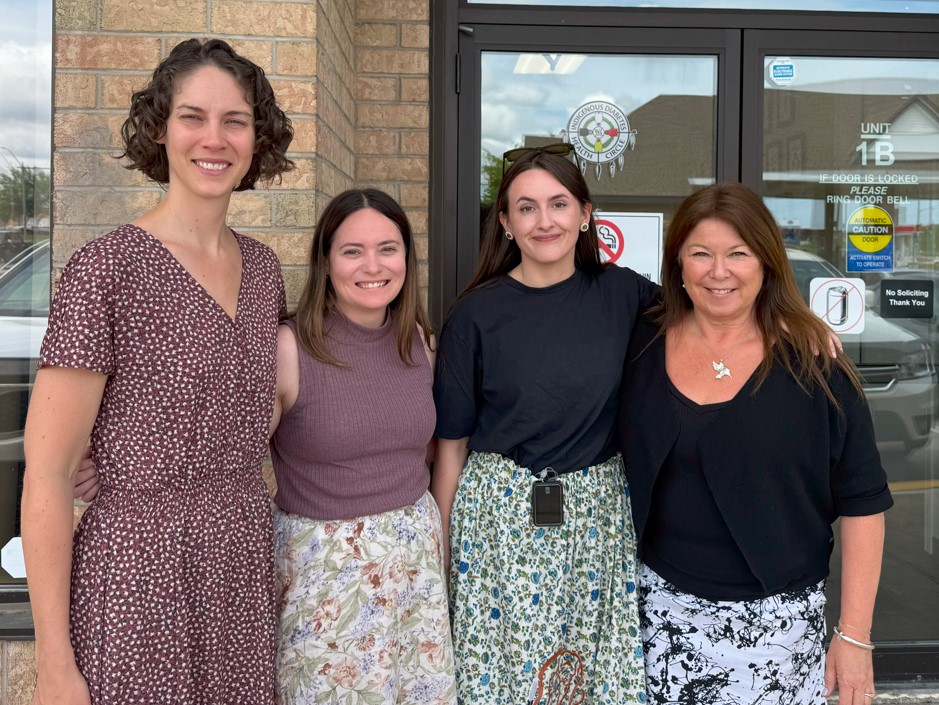
From left to right: Breakthrough T1D Canada staff members Lara Green and Lauren Germain, along with Justice Maki-Chambers and Roslynn Baird, Client Services Administrator, and Godrihwasido (Cayuga “Overseer”), Executive Director of IDHC respectively.
Breakthrough T1D Canada is partnering through a community grant to the Indigenous Diabetes Health Circle (IDHC) to help to address an unmet need with Canada’s Indigenous T1D community.
The grant will help support the development of community informed resources for Indigenous Canadians living with T1D.
Breakthrough T1D had the opportunity to speak with Justice Maki-Chambers, the lead on the project about how it came about and will roll out to improve support and health outcomes for Canada’s Indigenous T1D communities.
Tell us a little bit more about yourself
My name is Justice Maki-Chambers, and I’ve been working as an Eye Health Lead at IDHC for about 3 years. Our Eye Health program focuses on culturally informed approaches to diabetic retinopathy screening in Indigenous communities, in partnership with Vision Loss Rehabilitation Canada (VLRC). On a personal note, I was diagnosed with T1D when I was 16 years old, nearly 10 years ago. Like it is for most people, it was a hard adjustment. This shaped my passion for diabetes education and community-centered health education. Much of my work is grounded in building relationships, supporting self-determination in health, and making sure people have access to the tools they need to stay well.
How did you get involved with IDHC?
When I was working through my Public Health degree at Brock University, I frequently passed IDHC’s head office on my way to and from campus. I had remembered thinking “I am going to work there one day”. Years later, when I was nearing the end of my degree and needed a practicum, I reached out to see if there was any work I could do. Luckily for me, there was. This grew into a contract position within the Client Services Team, and then to a permanent position working on the Eye Health Screening Initiative. IDHC’s commitment to diabetes prevention and management, holistic wellness, and culturally grounded health education is something I’ve admired for a long time, and I am proud to now be a part of. It’s been humbling to contribute to a space where everyone works so tirelessly to uplift Indigenous wellness and create meaningful, lasting change.
Tell us a little bit more about how the IDHC plans to use the community grant to forward the needs of Indigenous diabetes communities in Canada
IDHC has plenty of resources regarding type 2 diabetes, pre-diabetes and gestational diabetes. While these resources can still be beneficial for people living with T1D, there are still important differences to consider, and we would like to support Indigenous individuals living with T1D in the same capacity. We have also had an influx in requests for T1D specific education due to a higher rate of T1D diagnoses in the past few years.
With this community grant, we have developed a Committee of Indigenous people with lived and loved experience to guide the project. We have been doing call outs to have others who live with T1D or are a caregiver of someone who has T1D be interviewed by our committee to hear what kind of resources are actually going to be useful. Once the interviews and surveys are complete, we will use them as a guide to create said resource. Ultimately, we are hoping to create a culturally grounded, accessible and practical and community-informed resource to better support Indigenous people and families living with T1D.
Any further message you want to share with the Canadian T1D community?
As we all know, living with T1D means constantly adapting, learning, and advocating for yourself and others in the T1D community, and this dedication does not go unnoticed. Everyone’s journey with T1D is a little different, but at the end of the day, we all deserve care that respects who we are, where we come from, and the strengths we carry. We deserve access, understanding, and resources that shift with us through our journeys. Chi Miigwech (Thank you) to everyone who has lived with diabetes and has fought for these resources and advancements to make our lives better and thank you to everyone who comes after us to continue this important work.
Surveys to help inform the development of these new materials and resources are available below:
Survey for Indigenous people living with T1D and their caregivers
https://soadi.wufoo.com/forms/s1nee8th050bbl5/
Survey for community health workers and healthcare providers with Indigenous patients living with T1D