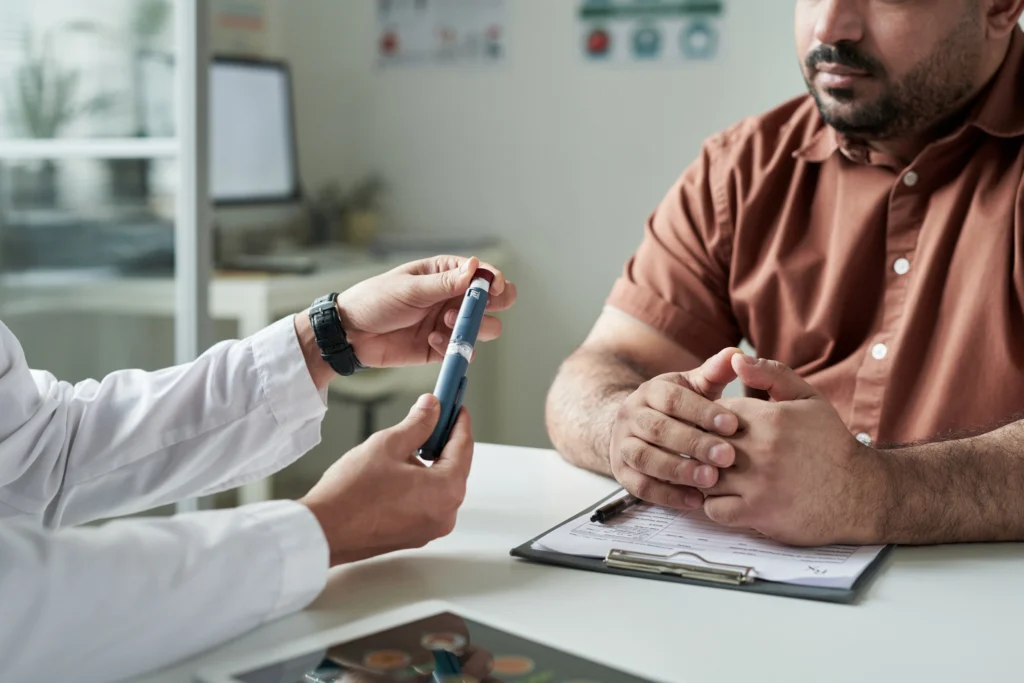
A new Breakthrough T1D-funded clinical trial led by Drs. Ahmad Haidar and Melissa-Rosina Pasqua (McGill University), is exploring whether tirzepatide, a commonly used medication for type 2 diabetes, can improve automated insulin delivery (AID) systems.
What is tirzepatide?
Tirzepatide is a type of adjunct-to-insulin therapy for diabetes called GLP-1RAs, short for glucagon-like peptide-1 (GLP-1) receptor agonist. GLP-1RAs allows the pancreas to better respond to GLP-1 hormone signals that are released after eating. This hormone helps to manage blood glucose and weight gain by suppressing the release of glucagon, stimulating insulin production (in non-T1D individuals), and slowing the rate at which the stomach empties thereby reducing appetite and increasing the sensation of being full.
Tirzepatide is currently approved by Health Canada for use in type 2 diabetes (Mounjaro) and weight management (Zepbound) but is currently not approved for use with T1D.
What is Dr. Haidar’s trial examining?
Drs. Haidar and Pasqua’s Breakthrough T1D-funded trial will examine if tirzepatide can help improve glucose management for people with T1D using Automated insulin delivery (AID) systems.
AID (or hybrid closed loop) systems consist of an insulin pump and continuous glucose monitor (CGM) that are connected via an algorithm to automatically adjust insulin delivery based on blood glucose levels. However, most current systems are still considered “hybrid” because users must manually count carbohydrates and deliver insulin boluses before meals. This step remains one of the most burdensome parts of diabetes management.
This new study aims to take the next step forward: enabling fully closed-loop insulin delivery, where the system manages glucose control entirely on its own, without requiring users to announce meals or count carbohydrates. The trial will assess if tirzepatide can help achieve this goal.
How will tirzepatide replace or reduce meal announcements and carb counting?
With current AID systems, meal-time insulin dosing remains necessary because of a mismatch in timing:
- Glucose from food enters the bloodstream quickly
- Insulin delivered under the skin acts more slowly
This delay leads to post-meal (post-prandial) spikes in blood glucose levels if meal boluses are not given in advance. Tirzepatide works to address the timing mismatch by:
- Slowing gastric emptying which delays how quickly glucose enters the bloodstream
- Supressing glucagon (a hormone that raises blood glucose) which will help reduce post-meal spikes
- Reducing appetite which lowers food intake and daily insulin requirements
Together, these effects may reduce the mismatch between food absorption and insulin action, making it easier for an automated system to maintain stable glucose levels without manual intervention.
Clinical trial details
A Clinical Trial Using Tirzepatide to Help Adults with Type 1 Diabetes Automatically Control Their Blood Sugar (TZP) is estimated to run in Montreal from 2026 to 2029.
The study will involve 105 adults using the Tandem Control-IQ technology, a commercial AID system. In the initial study stage, all participants will use the pump in its hybrid mode, which still requires users to manually give themselves insulin bolus doses before meals. In the final weeks of the study, participants taking tirzepatide will switch to a fully automated (“closed loop”) mode, where the system manages insulin delivery without these manual meal boluses.
This study will be conducted in collaboration with the Institut de recherches cliniques de Montréal (IRCM) (Rémi Rabasa-Lhoret, MD, PhD) and the University of Bern (Lia Bally, MD, PhD; Christoph Grani, MD, PhD; and Maricel Peters, MD, PhD).
To learn about other clinical trials you may be eligible to participate in: Breakthrough T1D – Clinical Trials
How does this study align with clinical practice
Recently updated Clinical Practice Guidelines released by Diabetes Canada recommend that adjunctive therapies may be considered in adults with T1D, based on shared decision-making with the care provider.
The same updated guidelines also recommended that insulin be delivered ideally by an insulin pump integrated with a continuous glucose monitor (CGM) in an AID system and that these devices be offered to all individuals with T1D, provided they are willing to wear the device and operate it.