JDRF Announces Launch of global Type 1 Diabetes Index 

The first-of-its-kind index will raise awareness of the burden and unmet need of people living with type 1 diabetes around the world. 

JDRF, the leading global type 1 diabetes (T1D) research and advocacy organization, announces the launch of the Type 1 Diabetes Index (T1D Index). The T1D Index is a first-of-its-kind data simulation tool that measures the human and public health impact of the T1D crisis in every country across the globe. Until now, there have been wide gaps in the data about the incidence and impact of T1D. Leveraging data and insights from the T1D Index can help change the lives of people living with T1D by identifying attainable country-by-country interventions including timely diagnosis, accessible care and funding research that could lead to cures. 

The T1D Index and accompanying research has been published in the world leading diabetes and endocrinology medical journal, The Lancet Diabetes & Endocrinology.

T1D is an autoimmune condition and one of the fastest-growing chronic health conditions, impacting nearly nine million people across the globe. Certain factors like family history can increase risk, but it is not caused by diet or lifestyle. T1D causes the pancreas to make very little insulin or none at all—this means the human body cannot convert food into energy, which can lead to long-term complications including damage to the kidneys, eyes, nerves, heart and even premature death. There is currently no cure for T1D.  

“As a member of the T1D community, I know many are not as fortunate as I am to have the resources necessary to live a healthy and fulfilled life,” Aaron Kowalski, Ph.D., JDRF CEO, said. “This is why I am so proud that significant progress has been made to understand T1D’s global impact through the T1D Index. We are calling on government and public health decision makers throughout the world to utilize the tool to identify and implement interventions that can change the trajectory of T1D.” 

“The Index provides unprecedented opportunities not only to measure the true impact of T1D, but to enable positive changes,” said Dr. Sarah Linklater, JDRF Canada’s Chief Scientific Officer. “The ability of the Index to look at trends over time shows the incredible progress we’ve made in terms of improving lives – but it also shows how much work remains to ensure that T1D will not diminish the quality or length of life for people affected in the future.”   

JDRF collaborated with key partners and experts around the world to develop the T1D Index–using the results from a global survey of more than 500 endocrinologists and 400 publications to simulate the state of T1D globally and at the country level.  

The Index uniquely illuminates the human burden of T1D by highlighting “missing people,” which is the number of people who would still be alive today if they had not died early due to complications from T1D, and “healthy years lost,” which represents time lost to ill-health, disability or early death from living with T1D.  

Simulations from the T1D Index suggest that globally as of 2022 there are more than 3.86 million “missing people” and an average of 32 “healthy years lost” to T1D per person, if diagnosed at age 10.   

T1D has a profound human, emotional and financial burden for those who live with it–and prevalence is on the rise. Simulations from the T1D Index have led to the identification of four key interventions that could change the current trajectory for T1D and its impact on people around the world: 

  • Timely diagnosis: enabling better education and training for medical professionals to accurately diagnose T1D. If the global population has access to timely diagnosis from 2023, 668,000 more people could be alive in 2040.  
  • Insulin and strips: creating barrier-free access to insulin and blood glucose testing strips. If the global population has access to insulin and testing strips from 2023, and coaching to self-manage the condition, 1.98 million more people could be alive in 2040.  
  • Pumps and CGMs: ensuring everyone living with T1D has access to technology that automates glucose monitoring and insulin delivery. 673,000 more people could be alive in 2040 if everyone with T1D has access to the technology available from 2023.  
  • Prevention and cures: making the case for further investment and research in emerging prevention, treatments and cures. 890,000 more people could be alive in 2040 if we find a cure. 

Once interventions are identified on the global and country level, the T1D Index encourages users to take action by sharing the data and findings with their networks and local decision makers, and connecting with other T1D advocates in their communities.  

Additionally, the T1D Index shines a light on important statistics about the burden of T1D globally, including: 

  • Since 2000, T1D prevalence has increased at four times the rate of global population growth. 
  • The expected number of people living with T1D in 2040 will be 17.43 million.  
  • The number of “missing people” in the year 2040 is projected to be 6.85 million in the absence of new initiatives that improve access to care, supplies, or cure and prevention therapies 

The T1D Index data simulations are the best estimate currently available with version 1.0 testing to +/- 6 percent against real-world data. This is a significant improvement from leading existing estimates that test to +/- 35 percent against the same data. It is a collaborative development by JDRF, Life for a Child, International Society for Pediatric and Adolescent Diabetes (ISPAD), International Diabetes Federation (IDF), and Beyond Type 1. The T1D Index is supported by founding corporate sponsor, Abbott Diabetes Care, with additional support from Lilly, Vertex Pharmaceuticals and The Leona M. and Harry B. Helmsley Charitable Trust. In future releases, the Index will expand to include T1D’s impact on economic costs, mental health and quality of life. The data will also be broken down at regional and demographic levels. 

You can learn more about the T1D Index here.* 

*currently available in EN only 
All Canadians with type 1 diabetes will qualify for the Federal Disability Tax Credit

June 23, 2022, Toronto, ON – JDRF is thrilled to announce that the approximately 300,000 Canadians living with type 1 diabetes (T1D) can now automatically qualify for the federal disability tax credit. The disability tax credit (DTC) is a non-refundable tax credit that helps people with disabilities or their support people/family members reduce the amount of income tax they may have to pay. This will undoubtedly ease the financial burden caused by unavoidable and necessary life-saving expenses faced by everyone with T1D.

This change is as a result of years of advocacy. From testifying at committee, to meeting with MPs and policymakers, to sending hundreds and thousands of letters, JDRF is extremely pleased with this announcement.

T1D is an expensive disease, often requiring financial assistance to cover the devices and supplies associated with the daily management of this chronic condition.

Since 2017, JDRF has been actively seeking change in the Disability Tax Credit when a controversial new tax directive introduced by the Canada Revenue Agency (CRA) made it virtually impossible for adults with T1D to qualify for the DTC. JDRF and the T1D community across the country came together in a campaign to demand that the new interpretation be rescinded. As a result, the Government of Canada and CRA announced they would rescind the interpretation, making it possible for adults with T1D to qualify for the DTC again.

However, individuals were still being denied due to the arbitrary and antiquated eligibility criteria, namely, the 14-hour requirement. In 2019, The Fairness for Persons With Disabilities Act was introduced and would reduce the number of hours needed to qualify for the DTC from 14 to 10.

In the same year, the Minister of National Revenue formed the Disability Advisory Committee (DAC) who produced an annual report that stated: “Instead of having to submit an account of the number of times and hours per week involved in these therapies, the person needing life-sustaining therapy should automatically meet the criteria”.

The previous requirements for the Disability Tax Credit were rife with inequities in access due to arbitrary and outdated practices. The new amendment will automatically qualify Canadians living with T1D, removing a significant barrier to care.

We want to thank everyone who testified, sent letters, attended meetings, shared stories and advocated for this change.

“This is incredible news for the type 1 diabetes community,” said Dave Prowten, President and CEO of JDRF Canada. “We want to thank the all Members of Parliament and Senators that supported this amendment and know that this will deliver much-needed support to thousands of Canadians living with type 1 diabetes,” he continues.

After many years of meetings with elected officials and policymakers, a budget promise came down in 2021 that would expand the list of activities that could be considered under the 14-hour requirement.

“We celebrated this as a win, hoping this would make qualifying for the DTC easier. However, automatic qualification is what we knew would make all the difference,” says Monica Kocsmaros, JDRF’s Chief External Relations Officer. “So, we decided to push further, lobbied MPs, met with policymakers, and leveraged the Juvenile Diabetes Caucus to get our message across to all decisionmakers.”

In May 2022, MP Jake Stewart introduced an amendment at the Standing Committee on Finance (FINA) that would make automatic qualification a reality for everyone living with type 1 diabetes. Members of FINA across all party lines voted unanimously to pass the amendment.

Over the past couple of months, the Bill went through pre-study, first, second and third readings, and was officially given Royal Assent today on June 23, 2022. This is a historic change that will allow everyone living with T1D to automatically qualify for the Disability Tax Credit.

JDRF is incredibly pleased with this announcement and looks forward to continuing to work with the government to make lives easier for the T1D community.

JDRF works every day to change the reality of this disease for millions of people globally—and to prevent anyone else from ever knowing it—by funding research, advocating for government support of research and new therapies, ensuring new therapies come to market and offering support through connecting and engaging the T1D community.

Quotes
“Type 1 diabetes is the cause of undue hardship for over 300,000 Canadians living in this country. By automatically qualifying these individuals for the Disability Tax Credit, this bill will provide meaningful support and reduce the amount of barriers they face. It is with great pleasure to work alongside our government and colleagues of the All-Party Juvenile Diabetes Caucus in delivering this important change for the type 1 diabetes community.” – Marie-France Lalonde, MP – Orléans, Co-Chair of the All-Party Juvenile Diabetes Caucus

“As Co-Chair of the All-Party Juvenile Diabetes Caucus, I am delighted by today’s passing of Bill C-19. As a chronic disease without a cure, type 1 diabetes places a significant physical, mental, and financial burden on the individual and their family. I am proud to see all parties united behind this cause to better support the type 1 diabetes community in Canada.” – Carol Hughes, MP – Algoma–Manitoulin–Kapuskasing, Co-Chair of the All-Party Juvenile Diabetes Caucus

“Today we join Canadians impacted by type 1 diabetes in celebrating a change to the Disability Tax Credit. Helping these individuals disproportionately impacted by this disease will not only allow them to afford the supports they need to stay healthy, but it will also go towards helping them live the dignified life they deserve. I am proud to work alongside my colleagues from all parties as the Co-Chair of the All-Party Juvenile Diabetes Caucus to deliver this change.” – Chris d’Entremont, MP – West Nova, Co-Chair of the All-Party Juvenile Diabetes Caucus

For more information contact:
Luka Stevanovic, National Director, Government Relations & Advocacy
JDRF/FRDJ Canada
lstevanovic@jdrf.ca

Government of Canada Approves $30M Joint Funding for Type 1 Diabetes Research

June 16, 2022 – JDRF Canada celebrates the approval of a joint investment of $30M for the JDRF-CIHR Partnership to Defeat Diabetes. We thank the government for this significant investment that will positively impact the type 1 diabetes (T1D) community.

The JDRF-CIHR Partnership to Defeat Diabetes is a landmark collaboration between the Government of Canada, through the Canadian Institutes of Health Research (CIHR), and JDRF Canada to support transformative T1D research. This unique partnership ensures that T1D remains a priority in Canadian health research and is based on a shared vision of improved care, treatment, outcomes and cures for those living with T1D. All funds donated by the Government of Canada are matched by JDRF through generous support from donors.

Since its inception in 2017, and now with this renewal, the JDRF-CIHR Partnership to Defeat Diabetes will invest a total of $60 million to fund the most promising T1D research. Over the past five years, the partnership has funded several innovative clinical trials and translational research projects focused on accelerating the development of novel treatment approaches for people with T1D. For example, Dr. Maria Cristina Nostro at the University Health Network’s McEwen Stem Cell Institute is leading a team focused on developing new transplantation strategies and universal donor stem cells to develop a superior islet-like product for people with T1D that will require little or no immunosuppression.

JDRF’s pre-budget submission for the 2021 Budget focused on the key recommendation that: The Government of Canada should honour the centenary of the discovery of insulin through a renewed research investment of $15M in the JDRF-CIHR Partnership to Diabetes to be matched by JDRF and its partners for a total impact of $30M.

In fall 2020, JDRF youth ambassadors took to Parliament Hill virtually as part of our Kids for a Cure lobby day. Delegates met with Members of Parliament and Senators to raise awareness about the daily challenges faced by those living with T1D and the need for more Canadian research in this field – specifically through the Partnership.

JDRF would like to recognize the support received from MPs and Senators to move this recommendation forward. We’d especially like to acknowledge our All-Party Caucus Co-Chairs, Marie-France Lalonde, Chris d’Entremont, Carol Hughes and Senator Nancy Hartling for their hard work and effort securing the Partnership renewal.

JDRF is excited to move forward with supporting additional cutting-edge T1D projects as a result of receiving renewed funding that will address areas of shared strategic interest including general population screening for T1D risk, precision medicine for T1D, and novel interventions that address mental health in people with T1D.

Quotes
“Receiving this crucial funding through the CIHR partnership will ensure Canada continues as a world leader in T1D clinical trials and translational research – especially as we marked the centenary of the discovery of insulin in 2021. We are fortunate to be working alongside our partner, CIHR, to reach our ultimate goal of finding a cure and moving beyond insulin.”
Dave Prowten, President and CEO of JDRF Canada

“The discovery of insulin over 100 years ago has kept us alive with this disease. Now we need to take action so that we can live a near normal life by using new technologies while we accelerate our focus on finding a cure for the next generation. A cure would mean that me, my son and all the rest of us living with type 1 or type 2 diabetes would no longer live the burden of managing this disease.”

Dr. Michael C. Riddell, T1D researcher who was diagnosed with T1D at age 15, and whose son was diagnosed with T1D in May 2016.

“I am very proud to see the federal government renew the partnership between JDRF and CIHR. This $15 million investment, to be matched by JDRF, is a landmark collaboration between the Government of Canada and JDRF Canada to support innovative T1D research. Ce partenariat, fondé sur une vision commune de l’amélioration des soins, des traitements et des résultats, vise également à trouver un remède pour les millions de Canadiens qui souffrent du diabète de type 1. For the other co-chairs of the All-Party Caucus on Juvenile Diabetes and myself, this is proof that through advocacy and partnership we can make great things happen. We firmly believe that by working together, the government of Canada and JDRF can better the lives of Canadians living with type 1 diabetes and turn type 1 into type none.”
Marie-France Lalonde, MP for Orléans

“As one of the Co-chairs of the All-Party JDRF Caucus I am pleased of the work we have done to support JDRF’s request for renewed research funding. I look forward to seeing how Canada’s $15 million commitment over the next five years helps support those who live with condition today while driving the work that will create a brighter future with hope for the eventual eradication of the condition.”
Carol Hughes, MP for Algoma—Manitoulin—Kapuskasing

“Canada is home to outstanding diabetes researchers. CIHR is very proud to partner with JDRF Canada to support excellent new research that will provide insights into how we can improve care and ultimately prevent and cure type 1 diabetes.”
Dr. Norman Rosenblum, Scientific Director, CIHR Institute of Nutrition, Metabolism and Diabetes

All Canadians with type 1 diabetes could soon access Federal Disability Tax Credit

Unanimous vote of members of the Standing Committee on Finance (FINA) brings equitable access to the Disability Tax Credit closer

Thursday June 2, 2022, Toronto, ON – This week we saw a major step forward in the effort to ensure all Canadians living with type 1 diabetes (T1D) can access the federal Disability Tax Credit. Members of the Federal Government’s Standing Committee on Finance (FINA), representing all parties, voted unanimously to pass an amendment that will ensure all Canadians living with type 1 diabetes can access the tax credit and ease the financial burden caused by unavoidable and necessary life-saving expenses. Over 300,000 Canadians currently live with T1D.

T1D is an expensive disease, often requiring financial assistance to cover the medications, devices, and supplies associated with the daily management of this chronic condition. The motion to amend the Budget Bill (C-19) was unanimously approved by the FINA committee and is intended to address longstanding issues with how the Disability Tax Credit has been accessible to Canadians with T1D.
The current requirements for the Disability Tax Credit are rife with inequities in access due to arbitrary and outdated practices. The proposed amendment before Parliament to the Income Tax Act would automatically qualify Canadians living with T1D, removing a significant barrier to care.

Members of the Standing Committee on Finance discussed and unanimously passed the motion on Monday, May 30 after hearing from experts in the medical community and families impacted by T1D about the need for change.

The committee heard personal stories, like that of Matt Stimpson, who lives with T1D and applied for the Disability Tax Credit at the same time as his 14-year-old daughter Tilly. Tilly was approved, and Matt was not, even though they live with the same condition and their costs incurred are relatively the same.
Among the witnesses, Dr. Alanna Weisman, an endocrinologist at Mt. Sinai Hospital implored the committee to address the problem of arbitrary hours of weekly care required to access the Disability Tax Credit. “People with type 1 diabetes should not have to worry about how they are going to pay for insulin, supplies, advanced glucose monitoring devices or insulin pumps. Those costs exist regardless of how much time is spent per week on the management of their disease,” she explained.

Individuals with T1D report spending up to $15,000 per year out of pocket on these unavoidable, life-saving costs.

“It has been really sad to see people with type 1 diabetes denied the Disability Tax Credit due to how forms were filled out, or because of an arbitrary number of hours it stipulates they must spend managing the particularities of their disease,” said Dave Prowten, President and CEO of JDRF Canada. “This motion moves forward a correction to an injustice that people with type 1 diabetes have been living with for too long. We are looking forward to watching Parliament debate the amended bill C-19 and are hopeful the bill will carry and deliver much-needed support to thousands of Canadians living with type 1 diabetes,” he continues.

Since 2017, JDRF has been actively seeking change in the Disability Tax Credit.

“The T1D community is elated with this progress and support from all FINA members. We look forward to continued support across all party lines for much-needed amendment,” says Anne Pettigrew, National Youth Champion with JDRF Canada.

JDRF works every day to change the reality of this disease for millions of people globally—and to prevent anyone else from ever knowing it—by funding research, advocating for government support of research and new therapies, ensuring new therapies come to market and offering support through connecting and engaging the T1D community.

“We must keep up the pace of funding and policy change so progress doesn’t slow or stop entirely, and we can turn type one into type none,” added Pettigrew.

For more information contact:
Michelle van Vliet
National Director, Marketing and Communications
JDRF/FRDJ Canada
mvanvliet@jdrf.ca

2022 Sun Life Walk to Cure Diabetes for JDRF returns in-person in over 30 communities across Canada

Thousands will Step Up to raise funds for type 1 diabetes research

TORONTO, ON — June 1, 2022 – The Sun Life Walk to Cure Diabetes for JDRF is the largest fundraising event in Canada that brings together the type 1 diabetes (T1D) community to unite and raise funds for T1D research with the goal of raising $2.8M this year.

During the month of June, Walk events will once again be held in-person across the country, bringing together those impacted by T1D. A fun-filled family and community celebration, the Walk is in its 29th year and has raised more than $135M to date. Funds raised will help support and create a difference for the 300,000 Canadians living with T1D.

This year marks the centenary of the first successful injection of insulin in a human. Insulin has saved millions of lives but those living with T1D still require it to stay alive. That is why continued investment in ground-breaking research, such as stem cell-based treatments that can produce insulin in those living with the disease, is crucial for improved treatments and cures.

“We are thrilled that we can once again reunite the type 1 diabetes community at in-person Walks across Canada. It is truly inspiring to see the passion and dedication of these families and their resolve to both support each other and to create a world without type 1 diabetes,” says Dave Prowten, President and CEO of JDRF Canada. “Every step is a step closer to a cure, and funds raised from the Sun Life Walk to Cure Diabetes for JDRF will help to accelerate the pace of the most promising type 1 diabetes research.”

Sun Life has been the National Sponsor of the Walk since 2014 and increased its already strong commitment to diabetes in Canada by becoming the National Title Sponsor of the Walk in 2018.

“Type 1 diabetes continues to be diagnosed in more and more Canadians every day and there is still no cure. That is why we have committed over $42M globally in support of diabetes awareness, prevention, care, and research initiatives since 2012,” said Milos Vranesevic, Senior Vice-President, Chief Marketing Officer, Sun Life. “The work JDRF is doing is critical to raising awareness and funds to help those affected. Sun Life is committed to the health and wellness of everyone in our communities and we are proud to sponsor the Walk for the seventh year to help those with type 1 diabetes live healthier lives.”

Learn more about the 2022 Sun Life Walk to Cure Diabetes for JDRF and help us move T1D research forward faster: jdrfwalk.ca

About JDRF

JDRF is the leading global organization funding type 1 diabetes (T1D) research. Our mission is to accelerate life-changing breakthroughs to cure, prevent and treat T1D and its complications. To accomplish this, JDRF has invested more than $3 billion CAD in research funding since our inception. We are an organization built on a grassroots model of people connecting in their local communities, collaborating regionally for efficiency and broader fundraising impact, and uniting on a national stage to pool resources, passion, and energy. We collaborate with academic institutions, governments, and corporate and industry partners to develop and deliver a pipeline of innovative therapies to people living with T1D. Our staff and volunteers throughout Canada and six international affiliates are dedicated to advocacy, community engagement and our vision of a world without T1D. For more information, please visit breakthrought1d.ca.

Sun Life in the Community

Sun Life is committed to building sustainable, healthier communities for life. Community wellness is an important part of its sustainability commitment. By actively supporting the communities in which Sun Life lives and works, the organization can help build a positive environment for Clients, employees, advisors, and shareholders. Its philanthropic support focuses on health, with an emphasis on diabetes awareness, prevention, and care initiatives. Mental health is also a key priority, with support for programs and organizations with an emphasis on building resilience and coping skills. Sun Life also partners with sports properties in key markets to further its commitment to healthy and active living.

For more information:

Michelle van Vliet
National Director Communications and Marketing
Cell: 514-803-0877
mvanvliet@jdrf.ca

Prince Edward Island announces coverage for continuous glucose monitoring systems under the Diabetes Glucose Sensor Program

Toronto, ON – The provincial government of Prince Edward Island made a historic announcement today about providing better access to continuous glucose monitoring (CGM) systems for people living with diabetes in the province. Complete public coverage for CGM devices will now be provided for people with type 2 and type 1 diabetes (T1D) age two and over who rely on multiple daily injections of insulin (three or more) or use an insulin pump, through Prince Edward Island’s Diabetes Glucose Sensor Program. This announcement complements the existing Diabetes Drug Program and the Insulin Pump Program that helps in covering costs of insulin and insulin pumps in the province.

“JDRF Canada joins Prince Edward Island’s T1D community in celebrating today’s exciting news,” says Dave Prowten, President and CEO, JDRF Canada. “Advanced glucose monitoring devices are truly life-changing and live-saving technology for people with diabetes. They allow better control of daily self-management, and for those who rely on remote or virtual care, these devices are critical in providing patient data to clinicians, allowing for better virtual care. Coverage for these devices in Prince Edward Island reduces the one of many out-of-pocket costs associated with T1D, he continues.

Measuring and managing blood glucose is an essential aspect of daily management for people living with T1D. Advanced monitoring systems such as CGM and Flash GM demonstrably improve a person’s quality of life. These devices help by continuously measuring glucose levels and transmitting real-time data to users, their parents, or caregivers. Users are notified in advance if they are at risk of hypoglycemia (low blood glucose levels), which carries symptoms such as shakiness, dizziness, sweating, increased heartbeat, mood changes, fainting risk and more.

Being able to check blood glucose levels in real-time improves self-management, reduces the risk of long-term complications, and can provide relief for some of the anxiety associated with living with T1D. It also allows people with T1D to exert better control over the activities of daily living.

JDRF is incredibly pleased with Prince Edward Island’s decision to offer complete and comprehensive coverage, being the first province to offer public coverage for advanced glucose monitoring devices in Atlantic Canada. This is encouraging news for many living in the region who are hopeful to see government support in their own province to help alleviate significant financial burdens brought on by T1D. While there has been progress made in recent years to provide equitable access across the country, many Canadians living with T1D are still without coverage and are at risk. That is why JDRF Canada launched its Access for All campaign to support the T1D community and advocate for the thousands of Canadians who must pay out-of-pocket for life-sustaining technology due to lack of coverage. Until a cure can be found, JDRF Canada will continue to engage with legislatures from coast to coast and advocate until such time as there is universal access for all Canadians who need it.

For more information, visit: P E.I. Glucose Sensor Program or contact diabetesadminofficer@ihis.org or call 1-833-355-0538.

Temerty Foundation Makes History with $10 Million Gift to JDRF, the Largest Single Donation to Type 1 Diabetes Research in Canada

Toronto, ON – March 30, 2022 – James and Louise Temerty have made a transformational $10 million commitment to help fund JDRF’s efforts to find a cure for type 1 diabetes (T1D). The family’s investment through Temerty Foundation is the largest single gift ever made to T1D research in Canada. This extraordinary donation comes 100 years after Banting and Best saved millions of lives with the discovery of insulin, celebrated as Canada’s gift to the world.

“We were at a loss for words to express our gratitude and jubilation when Temerty Foundation made their commitment to JDRF,” says JDRF President & CEO Dave Prowten. “The hope this gift will provide to our type 1 diabetes community is priceless. The Temerty’s incredible donation will accelerate the pace of research and will help inspire and rally Canadians around our bold vision of a world without this relentless disease.”

James and Louise Temerty are selfless philanthropic leaders and longtime supporters of a wide range of causes that improve lives in Canada and worldwide. Their foothold in the healthcare space is especially vast – the Temerty name is synonymous with championing medical research in Canada. And any discovery made in Canada has the potential to benefit people living with T1D around the world.

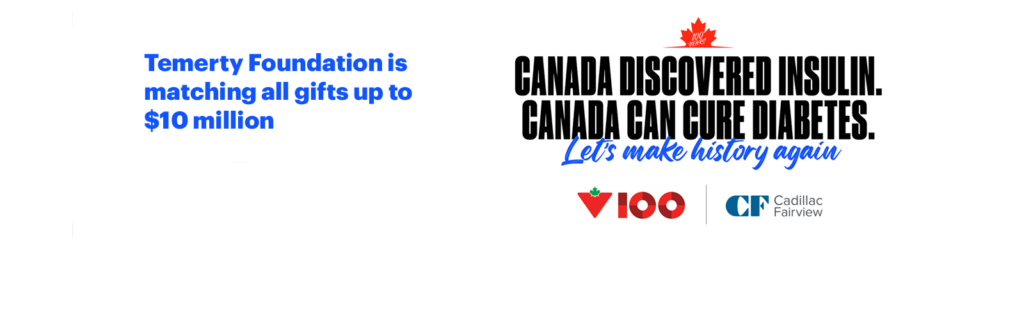
The Temerty family wants to inspire others to step forward, so they are giving this gift as a challenge – matching all gifts up to $10 million until May 31, 2022, to JDRF’s $100M Campaign to Accelerate and the Let’s Make History Again event. In just 20 months, JDRF’s campaign has reached 50% of its goal to accelerate the pace of T1D research.

To launch this Campaign publicly, JDRF is doing something bold and making history. Five brave people impacted by T1D will live atop 40-foot flagpoles for 100 hours in Vancouver, Calgary, two locations in Toronto, and Montreal from April 4 to 8, 2022. Joining them in solidarity are 100 families and individuals camping out across the country.

When James and Louise heard about Let’s Make History Again’s goal of celebrating exceptional Canadian discovery and rallying the country to make a bold impact, they were compelled not only to give, but to up the ante with a matching challenge.

“We hope our gift will spark further investments in this important research, which builds upon the great Canadian discoveries of insulin, islet transplants and stem cells to find a cure for type 1 diabetes,” says James Temerty.

T1D is an autoimmune condition where the beta cells in the pancreas responsible for producing insulin are destroyed. It is a chronic disease that requires constant management. Insulin can only be administered externally, and every day is a balancing act of blood glucose levels, nutrition, rest and activity to try and stave off diabetes-related complications that can include blindness, kidney disease, coma and even potentially death. But there is hope. We are in a unique period of scientific progress in T1D, a renaissance where promising science is advancing at an unprecedented pace. James and Louise Temerty are leading a philanthropic movement to mark this historic moment and leverage the speed of research.

“History and experience have shown us that success requires a bold vision and relentless perseverance,” says Louise Temerty. “Our hope through this gift is that JDRF harnesses the determination of Canadians to drive life-changing breakthroughs in type 1 diabetes research. We encourage people across the country to join us by giving in whatever means they can to support the next great discovery in diabetes.”

Now is the time to double down to move us beyond insulin. We must build on Canada’s deep legacy of discovery, passion, and philanthropy by investing in the Canadian scientists leading the way to a cure. JDRF and Temerty Foundation invite Canadians to double the impact of their gifts by joining us in making history again. Learn more at canadacuresdiabetes.ca.

About JDRF

JDRF is the leading global organization funding type 1 diabetes (T1D) research. Our mission is to accelerate life-changing breakthroughs to cure, prevent and treat T1D and its complications. To accomplish this, JDRF has invested more than $3 billion CAD in research funding since our inception. We are an organization built on a grassroots model of people connecting in their local communities, collaborating regionally for efficiency and broader fundraising impact, and uniting on a national stage to pool resources, passion, and energy. We collaborate with academic institutions, governments, and corporate and industry partners to develop and deliver a pipeline of innovative therapies to people living with T1D. Our staff and volunteers throughout Canada and six international affiliates are dedicated to advocacy, community engagement and our vision of a world without T1D. For more information, please visit breakthrought1d.ca.

About Temerty Foundation

Since 1997, Temerty Foundation has provided significant philanthropic support to health care, education and culture in Toronto and beyond. In 2021, Maclean’s listed James and Louise Temerty as “the first name in medical philanthropy” in Canada, which honours their extraordinary investments in the Temerty Faculty of Medicine at the University of Toronto, the Centre for Addiction and Mental Health, and Sunnybrook Health Sciences Centre, to name a few. The Temertys also support the Royal Ontario Museum, the Royal Conservatory of Music, the Canadian Museum for Human Rights, and many Ukrainian programs such as Help Us Help, the Ukrainian Canadian Congress, and the Ukrainian World Congress. James founded the Ukrainian Jewish Encounter (UJE) to contribute to greater Ukrainian-Jewish understanding and mutual respect. Having grown up in Ukraine and with deep roots in his home country, James currently supports the Unite with Ukraine campaign through the Ukrainian World Congress, which funds protective equipment and medical supplies for volunteer fighters. Both James and Louise are recipients of the Queen Elizabeth II Diamond Jubilee Medal for service to their community, and James received the Order of Canada in 2008.

Media Contact:

Michelle van Vliet
National Director, Marketing and Communications
T. 514-803-0877
E. mvanvliet@jdrf.ca

JDRF Canada Sets Out to Make History Again

MEDIA RELEASE

As Canada Marks 100th Anniversary of First Successful Injection of Insulin, JDRF Canada Sets Out to Make History Again

Five Brave Canadian Volunteers Set to Live Atop a Flagpole for 100 Hours, Raising Funds to Find a Cure for Type 1 Diabetes

TORONTO, March 10, 2022 — JDRF Canada, the largest charitable funder of type 1 diabetes (T1D) research in the country, is publicly launching its largest-ever fundraising campaign, the $100M Campaign to Accelerate. The campaign aims to accelerate the pace of T1D research being done in Canada to help find a cure. Canada discovered insulin and by supporting research, Canada can cure diabetes.

To make history again, five brave Canadians impacted by T1D will live atop a 40-foot flagpole in cities across the country as part of JDRF’s Let’s Make History Again event. They will do this for 100 hours this spring, beginning on April 4, to help raise $15 million to help find a cure for T1D.

The Let’s Make History Again event honours the anniversaries of the discovery of insulin and the first successful injection of insulin—both of which took place in Toronto 100 years ago— while accelerating research to move beyond insulin and find a cure. The event features the Flagpole 100 challenge, which was inspired by Oliver & Bonacini Co-Founder and longtime JDRF supporter, Peter Oliver, who—32 years ago—lived atop a flagpole until he raised $250,000 for T1D research after his daughter’s diagnosis at the age of six. He attributed the inspiration for the flagpole to the endless balancing act of life and death decisions that those living with T1D face each day, which can feel extremely isolating, similar to being alone atop a flagpole.

“I still remember getting the call when my daughter Vanessa was first diagnosed at the age of six. We didn’t know a thing about diabetes, but Vanessa thought the ‘di’ in ‘diabetes’ meant you were going to die,” says Peter Oliver. “That day has stuck with me my whole life. I think of all the families and children that experience that same moment and I strongly believe when there is a cure for diabetes, it will go down as one of the greatest achievements in the history of mankind.”

When insulin was discovered 100 years ago in Toronto, Canada, researchers Frederick Banting and Charles Best sold its patent for only $1. It was considered one of Canada’s greatest gifts to the world, however those living with T1D still require insulin to stay alive.

Let’s Make History Again is truly a rallying cry for all Canadians who have been impacted by diabetes,” says Dave Prowten, President and CEO of JDRF Canada. “While the discovery of insulin in Canada 100 years ago has saved millions of lives, it is still only a treatment and not a cure. It is fitting that now is the time to map out the next era of discovery in type 1 diabetes research. Not only will this propel us forward in finding a cure for the disease, but it’s incredibly inspiring to see so many Canadians and families galvanized by this cause that touches the lives of so many.”

“With the help of the JDRF, researchers like myself are driving innovative research with the goal of improving strategies to treat or prevent T1D,” says Dr. Patrick MacDonald, Professor of Pharmacology at the University of Alberta. Dr. MacDonald’s JDRF-funded work aims to develop a comprehensive molecular encyclopedia about insulin-producing islet cells to uncover new approaches to improve glucose regulation as well as inform ongoing and future T1D cure research.

The five Leaders in History will unite atop 40-foot flagpoles in cities across the country for 100 hours to help raise $15 million for JDRF’s $100M Campaign to Accelerate from April 4 until April 8, 2022. The Leaders in History will head atop the flagpoles on April 4 at 11 a.m. local time and the public is welcome to stop by and show their support.

Flagpoles will be located at:
• Toronto-Dominion Centre, 55 King St W, Toronto, ON M5H 3C2
• UHN (Toronto General Hospital), 585 University Ave., Toronto, ON M5G 2C4
• 200 Granville Street, Vancouver, BC V6C 1S4
• Calgary City Centre, 215 2 St SW, Calgary, AB T2P 0H7
• Rio Tinto Indoor Courtyard 1160 Av. des Canadiens-de-Montréal, Montréal, QC H3B 2S2

Camping in solidarity with our Leaders in History will be our 100 Ambassadors of History families. These families will be camping in their local parks, backyards or even their basements, undertaking the challenge to support JDRF and raise funds to find a cure for T1D.

To get involved and make a lasting impact on the future of T1D research and care, JDRF invites Canadians to become History Makers. You can help JDRF make history again by registering and joining hundreds of people across the country who will be doing their own unique challenge to raising funds and awareness for JDRF. To learn more about getting involved visit canadacuresdiabetes.ca.

Some words from some of the JDRF’s incredible partners:

“It’s an honour to celebrate this remarkable achievement and help mark the 100th anniversary of the discovery and first successful injection of insulin in this country,” said Susan O’Brien, Chief Brand and Customer Officer, Canadian Tire Corporation. “As we celebrate our own 100th anniversary this year, we continue our longstanding commitment to making life in Canada better. We’re proud to partner with JDRF’s Let’s Make History Again initiative and commit $500,000 through a combination of financial support and in-kind donations to help find a cure for those living with type 1 diabetes.”

“At Cadillac Fairview, we have a strong legacy of supporting our communities, clients and partners and the causes that are important to them to inspire meaningful change,” said Sal Iacono, Executive Vice President of Operations, Cadillac Fairview. “This year’s centennial milestone event is an incredible accomplishment in the fight against type 1 diabetes and we’re proud to support the campaign by hosting the Flagpole 100 Challenge at four CF office towers across Canada and making a donation to support ongoing research. Together, alongside our longtime partner, Oliver & Bonacini, we are excited to make history with JDRF.”

“We are thrilled to see the enthusiasm and efforts of our employees and volunteers who have come together around the JDRF Flagpole 100 Challenge. The Walters Group family is passionate about making a difference!”, says Peter Kranendonk, Chief Executive Officer of Walters Group. “Building History is our purpose and this transformational campaign inspired us because we care about every fellow Canadian who struggles with or is affected by type 1 diabetes. These structures are being built with our hearts and our hands in the hope and with the prayer that all of us together will Make History Again with great therapies and a cure for T1D!”

“For more than 20 years, Dexcom’s singular focus has been to give people the power to change how they live with diabetes through our CGM technology. We are so excited to be partnering with JDRF Canada as they make history with the Flagpole 100 Challenge,” said Laura Endres, Senior Vice President and General Manager of Dexcom Canada. “One day there will be a cure for diabetes, but until then, we will work every day to empower people to take control of their diabetes and live life to the fullest.”

“We are so proud of our partnership with JDRF and Lilly was beyond excited to support a campaign acknowledging one hundred years of discovery, while inspiring Canadians to persist in our collective effort to beat diabetes,” says Rhonda Pacheco, General Manager, Lilly Canada “At PCL, we’re driven to build a better future by building people, communities and legacies. We are proud to contribute to JDRF through supporting and building the flagpoles to help commemorate the 100th anniversary of the discovery of insulin. We hope that through the combined efforts of all those involved, we can do our part to support JDRF’s mission of improving lives for those living with type 1 diabetes.” Mike Wieninger, Chief Operating Officer, Canadian Operations for PCL Construction

About JDRF

JDRF is the leading global organization funding type 1 diabetes (T1D) research. Our mission is to accelerate life-changing breakthroughs to cure, prevent and treat T1D and its complications. To accomplish this, JDRF has invested more than $3 billion CAD in research funding since our inception. We are an organization built on a grassroots model of people connecting in their local communities, collaborating regionally for efficiency and broader fundraising impact, and uniting on a national stage to pool resources, passion, and energy. We collaborate with academic institutions, governments, and corporate and industry partners to develop and deliver a pipeline of innovative therapies to people living with T1D. Our staff and volunteers throughout Canada and six international affiliates are dedicated to advocacy, community engagement and our vision of a world without T1D. For more information, please visit breakthrought1d.ca.

###

For further information please contact Laura Gannon at laura@pomppr.com.

In Memoriam

We are deeply saddened by the sudden passing of Andrew McKee, former President and CEO of JDRF Canada. Andrew began his journey with JDRF Canada as a Board member. His passion and dedication led him to assume the role of President and CEO for several years. Through his leadership, he blazed an exciting trail for our organization. Andrew was deeply committed to JDRF and the type 1 diabetes (T1D) community and was the driving force behind the creation of the JDRF Canadian Clinical Trial Network, which is an incredible partnership with our federal government and JDRFI. His legacy lives on through the research that was done by this network in Canada and around the world, and will continue to benefit people for years to come.

We extend our deepest condolences to his family and friends at this difficult time, and are grateful for his unwavering service to JDRF and the T1D community.

https://humphreymiles.com/tribute/details/6542/John-McKee/obituary.html#tribute-start

Ontario announces coverage for continuous glucose monitoring systems under the Assistive Devices Program

Friday, March 4, 2022 Toronto, ON – Today, the Ontario government made an exciting announcement that will provide better access for Ontarians with type 1 diabetes (T1D) to continuous glucose monitoring (CGM) systems. These devices will be covered under Ontario’s Assistive Devices Program (ADP), which also provides coverage for insulin pumps. ADP is available to Ontario residents who have a valid Ontario health card and can demonstrate that they have a condition requiring the equipment or supplies for six months or longer. 

“JDRF Canada is thrilled that Ontario will provide coverage for CGM devices to those living with type 1 diabetes. These technologies are critical in preventing life-threatening complications and improving health outcomes, while also providing rich data to clinicians, as we continue to rely on virtual care. Those living with type 1 diabetes in Ontario can now lead healthier, safer, and easier lives until a cure is found,” says Dave Prowten, President and CEO, JDRF Canada. 

T1D self-management is made easier through technologies such as CGMs which provide real-time readings that help to improve overall blood glucose (HbA1C) and time in target range (TIR) keeping more people out of hospital, and reducing longer-term complications. Better self-management and glucose control also helps to relieve some of the anxiety that surrounds the disease. It allows people with T1D to better plan exercise, meals, and rest. Universal coverage of CGM would increase the number of people living free of complications by an estimated 7,400 and decrease mortality by an estimated 11,500.   

“In the absence of government support, people living with diabetes will continue to pay out of pocket to manage the rising, additional costs. This could be upwards of $15,000 per year for one individual and will only increase the divide between those who can and those who cannot afford these technologies,” adds Prowten.  

In the past three years, there has been significant commitments from six provincial and territorial governments to improve access to diabetes technology. In Ontario, public coverage is available for both CGM and Flash GM. We applaud the government for recognizing the clear evidence of both the cost-benefit and quality of life outcomes these devices undeniably provide.  

JDRF welcomes today’s announcement from the Ontario government after ongoing advocacy efforts through the Access for All campaign to educate and inform decisionmakers of the benefits of funding these technologies. JDRF believes that patient choice is paramount to better T1D management. The organization will continue to advocate until there is universal access to advanced glucose monitoring devices and insulin pumps for all Canadians living with T1D.    

To learn more about JDRF’s #AccessForAll campaign visit: www.breakthrought1d.ca/accessforall 

For more information on the Assistive Devices Program, visit:  https://www.ontario.ca/page/assistive-devices-program

JDRF in the United States joining partners to support new affordable insulin project with a focus on the US market.

March 3, 2022 – Statement by Dave Prowten, President and CEO, JDRF Canada

JDRF has long supported both public and private sector initiatives to make insulin more affordable to ensure people with type 1 diabetes (T1D) can access the insulin they need to stay alive and healthy until we have cures.

Today, just two days after U.S. President Biden’s State of the Union address declared, “let’s cap the cost of insulin at $35 a month so everyone can afford it,” JDRF in the U.S., in partnership with a myriad of other health organizations, is announcing a new partnership with Civica Inc. (Civica Rx, Civica), a non-profit generic drug company. This innovative partnership will facilitate bringing a low-cost biosimilar insulin option to Americans at $30 per vial and $55 per box of 5 pens starting in 2024. As it is common for a vial of insulin in the United States to cost as much as $300USD – a significant barrier to care – more affordable access to low-cost insulin, the life-saving therapy anyone living with T1D requires, is essential.

In Canada, a vial of insulin costs on average between $30-$40CAD, with more than 90 per cent of those costs covered by some form of public or private insurance. These costs are regulated by the Patented Medicines Prices Review Board (PMPRB) which limits the prices set by patentees for all patented medicines to ensure they are not excessive. In addition, the pan-Canadian Pharmaceutical Alliance (pCPA) works to negotiate directly with manufacturers to increase access to lower-cost drugs in Canada. With this regulatory process in place, and with the cost of insulin in Canada being exponentially lower than the United States, the initiative with Civica Inc. is not anticipated to expand here.

Anyone requiring life-sustaining therapy, such as those living with T1D, should never be unable to access or afford the treatments that keep them alive – like insulin. As a global charity, JDRF encourages countries to work collaboratively with all stakeholders to find ways to keep drug costs down worldwide.

JDRF Canada remains a strong advocate for the affordability and accessibility of all appropriate treatments, services, devices and medications (including insulin). As we know, anyone living with T1D requires insulin to stay alive. However, when that treatment is coupled with devices such as insulin pumps and advanced glucose monitors (CGM and Flash GM), self-management and health outcomes can significantly improve. Unfortunately, there are accessibility challenges with these devices due to limited coverage, as well as variability of public and private coverage, which leads to continued high out-of-pocket costs for many Canadians living with diabetes.

That is why JDRF Canada continues to advocate through our Access for All campaign to make T1D technology affordable and accessible for everyone living with this disease. Since its launch, thousands of Canadians have been able to access these technologies as provincial and territorial governments agree on the cost-benefit and quality of life outcomes these devices undeniably provide. JDRF continues to support the efforts of the T1D community so that equitable access to these life-saving technologies can be guaranteed across the country. To join our efforts, visit https://breakthrought1d.ca/advocacy/access-for-all/.

Donate | Donnez