Highlights from ADA 2026 Scientific Sessions

Crowd of people at a conference watching stage

The American Diabetes Association (ADA) Scientific Sessions are one of the world’s largest gatherings of diabetes researchers, clinicians, and industry leaders. More than 11,000 people came together in June 2026 to share the latest progress.

Here’s what matters most for our community.

What you need to know (30 seconds)

  • Progress in type 1 diabetes (T1D) is accelerating across multiple fronts, including cell therapies, immune therapies, technology and mental health.
  • Some early studies show that cell therapies could one day reduce or even eliminate the need for insulin for some people.
  • Researchers are working on treatments that target the root cause of T1D, not just blood sugar management.
  • Earlier detection and screening are expanding and could help delay or prevent T1D in the future.
  • Technology is improving daily life, but gaps remain, especially around preventing serious complications like diabetic ketoacidosis.
  • Canadian researchers and the Breakthrough T1D community are helping drive this progress forward.

Many scientific breakthroughs are coming together to improve daily life and bring us closer to cures.

Cell therapies: Moving closer to life beyond insulin

Why this matters

Cell therapies aim to replace the insulin-producing cells the body has lost. One day, this could mean fewer injections, or even the possibility of not needing insulin at all.

What’s new

At ADA 2026, cell therapies were a major focus.

  • Dr. Trevor Reichman (University of Toronto) chaired a key session on how to bring manufactured islet cell therapies to more people.
  • Dr. Sanjoy Dutta (Breakthrough T1D) highlighted the need to include the T1D community in how these therapies are developed and approved. In Canada, our efforts to make sure this happens are called Project ACT.
  • Researchers emphasized that current clinical trials are too limited, and expanding access will be critical.
  • A study using a new immunotherapy approach made by Eledon Pharmaceuticals showed that all 12 participants receiving islet transplants were able to stop using insulin, with no severe safety concerns reported.

There is also a strong focus on overcoming key barriers, especially reducing or eliminating the need for lifelong immunosuppression.

Canada & Breakthrough T1D in action

  • Dr. Alice Carr (University of Alberta) is leading Breakthrough T1D-funded research to understand who is most likely to benefit from islet transplants and how to improve outcomes
  • Pediatric perspectives were also highlighted by Dr. Brynn Marks (Breakthrough T1D), with contributions from Dr. Melena Bellin and Dr. Laura Jacobsen on what cell therapies could mean for children

These advances are being made possible because of the support of the Breakthrough T1D community – people living with T1D, families, and donors – who make this research possible.

Disease-modifying therapies: Treating the root cause

Why this matters

  • Researchers are developing therapies that target the immune system earlier in the disease, offering a way to slow or halt T1D progression.
  • Dr. Christoph Bausch (SAB Biotherapeutics) presented early clinical trial results for a therapy (SAB‑142) that improved time in range, reduced insulin use and may be safely re-dosed, opening the door to longer-lasting effects.

What’s new

This signals a major shift from managing T1D to changing how the disease progresses, which could fundamentally improve outcomes.

Canada & Breakthrough T1D in action

  • Breakthrough T1D, with the support of its community, is helping fund and advance these therapies through its research and investment efforts.
  • This work is helping move us closer to earlier intervention and, ultimately, prevention.

Early detection and screening: Finding T1D sooner

Why this matters

T1D develops over time before symptoms appear. Detecting it earlier could:

  • Reduce the risk of serious complications at diagnosis
  • Allow earlier access to therapies that may delay progression

What’s new

Screening programs are expanding globally using blood tests that detect early markers of T1D

  • Dr. Holly O’Donnell (Barbara Davis Center) presented research showing that families need clear, ongoing support when learning about T1D risk and that better understanding can also increase anxiety if not handled carefully.
  • Dr. Anastasia Albanese-O’Neill (Breakthrough T1D) shared emerging global recommendations for screening and emphasized the importance of participating in clinical trials.
  • Dr. Raquel Lopez Diez (Breakthrough T1D) is helping lead international collaboration on genetic risk scoring to better understand who is most at risk.

Canada & Breakthrough T1D in action

  • Canada is advancing toward wider screening through CanScreen T1D.
  • Breakthrough T1D-funded research is also helping address the emotional impact of early detection on families.

Technology: Making daily life easier while closing gaps

Why this matters

Technology has transformed how many people manage T1D, but there’s still work to do to make it accessible, simple, and safe for everyone.

What’s new

  • Automated insulin delivery (AID) systems continue to expand into more real-world settings.
  • In Canada, clinical practice guidelines now recommend AID systems for all people with T1D who are able to use them.
  • However, challenges remain:
    • Hospitalizations for diabetic ketoacidosis (DKA) have increased by about 24% over time.
    • Many people are not regularly monitoring ketones.
  • New innovations like continuous ketone monitoring are beginning to emerge, offering a future where ketone monitoring is as easy as continuous glucose monitoring.

Researchers acknowledged that technology also comes with trade-offs, including alarm fatigue, data overload, and emotional burden.

Canada & Breakthrough T1D in action

  • Dr. Alanna Weisman (Sinai Health, Toronto) is leading Breakthrough T1D-funded research to understand why some people face barriers to accessing diabetes technology, especially in underserved communities.
  • This research supports Breakthrough T1D’s work to ensure equitable access to technology across Canada.

Adjunct therapies: Expanding treatment options

Why this matters

Insulin is essential but it may not be the only tool in the future. Additional therapies could help improve overall health and outcomes.

What’s new

  • Researchers are studying medications like GLP‑1 therapies in people with T1D, especially youth.
  • These therapies may help with blood sugar management, weight management, long-term heart health (still being studied) and more.

Future care will likely be more personalized, combining insulin, technology, and other therapies based on individual needs.

Canada & Breakthrough T1D in action

Breakthrough T1D, with the support of the community, continues to invest in research that expands treatment options and improves quality of life for people living with T1D.

Mental Health: Support whenever you need it

Why this matters

Living well with T1D isn’t just about blood sugar. Emotional health matters too, and new tools are making support easier to reach.

What’s new

  • New digital tools are emerging to close this gap, making peer-led mental health support easier to reach.

Canada & Breakthrough T1D in action

  • Dr. Tricia Tang (University of British Columbia) is leading Breakthrough T1D- funded research on REACHOUT, a mobile app that connects adults with T1D to peer-led mental health support. It’s available anytime, day or night, tailored to each person’s needs, and delivered by a peer they choose.
  • In her study, people who used REACHOUT for six months saw greater improvements in their mental health than those still waiting to access it. Full results are expected soon.

Dr. Tang presented results of the wait-list, randomized control trial – meaning that anyone who participated in the trial was randomly selected to either receive the peer support immediately or were put on a waitlist and still answered surveys about their mental health while waiting for access to the REACHOUT app. This style of study allows for all interested participants to access the tool (albeit at various times) but also provides control data to compare to. Using the REACHOUT app for 6 months was successful in improving mental health outcomes compared to those not using the app on the waitlist. The full results are expected to be published

What this all means for our community

ADA 2026 made one thing clear: progress in T1D is not coming from just one breakthrough, but from many advances happening at the same time.

Together, these advances are:

  • Improving daily life
  • Reducing the burden of T1D
  • Bringing us closer to cures

And, importantly, this progress is powered by you.

Through advocacy, participation in research, fundraising, and lived experience, the Breakthrough T1D community is helping drive every step forward.

Spotlight on Dr. Patrick MacDonald: Expanding global knowledge of human islets

Image of Dr. Patrick MacDonald
Dr. Patrick MacDonald

To cure type 1 diabetes (T1D), we need to do two things: we need to address the autoimmune response that damages insulin-producing beta cells, and we need to replace lost beta cells to restore the ability to produce insulin.

Beta cells are found in clusters of multiple cell types in the pancreas. These clusters are called the islets of Langerhans – or islets for short.  In order to understand how to protect and replace islets, we need to know as much about ‘healthy’ islets as possible and why they are destroyed in someone with T1D.  Since islets can’t be studied within the body and islets can’t be donated by a living donor, researchers rely greatly on islets that are isolated from cadaveric pancreas donors.

Dr. Patrick MacDonald of the University of Alberta is a world leader in coordinating global islet samples and data for researchers, while fostering national training opportunities. Dr. MacDonald directs the Alberta Diabetes Institute (ADI) IsletCore, the world’s largest ‘single source’ of human pancreas research tissue.

“Our goal with the ADI IsletCore, and other efforts we are involved in, is to elevate diabetes and transplantation research across Canada and internationally. With human research tissue we feel it is essential to share experimental results widely, to honour the selfless gifts of organ donors and to benefit the entire diabetes community,” says Dr. MacDonald.

ADI IsletCore in Canada

ADI IsletCore isolates and ships islets and pancreas tissue to a network of nearly 200 research labs around the world.  With nearly 50 pancreas donors in 2025, they were able to distribute almost 7 million islet equivalent cells to researchers, bringing their grand total to 75 million islet equivalents distributed to date. This translates into over 300 scientific papers crediting ADI IsletCore for research support.

Islet database

With support from the Breakthrough T1D-CIHR Partnership to Defeat Diabetes, Dr. MacDonald and his team have developed a groundbreaking online database cataloguing the molecular, cellular, and physiological functions of islets from human organ donors acquired through ADI IsletCore.

HumanIslets.com allows researchers worldwide to explore islet function, proteins, and pathways comparing between donors with and without diabetes. They have leveraged this work for an additional $1.8M of funding including a Breakthrough T1D International grant for $750k to expand the platform to include stem cell-derived islets and integrate AI and machine learning into the analysis.

Dr. MacDonald’s research has significantly advanced cure research for T1D by integrating massive datasets from hundreds of human donors and making this resource publicly accessible.

International collaboration

Dr. MacDonald is now sharing his expertise internationally through collaboration on development of islet distribution centres.

In April 2026, Australia launched its first national Breakthrough T1D-funded islet distribution centre, which is critical given Australia’s remote location and need to collect local tissue for research. Dr. MacDonald is advising on this important new islet centre, that will further improve both global collaboration and our understanding of human islets.

In addition to his partnership in Australia, Dr. MacDonald is also collaborating on islet distribution programs in Michigan, USA and Sweden to further support a worldwide connected research network. He has recently published a paper in Diabetologia about coordinating global efforts to advance islet research through shared resources.

Training emerging leaders

Not only does Dr. MacDonald oversee IsletCore and run an active research lab, he also co-founded, and was the initial leadership group chair of, the Canadian Islet Research and Training Network (CIRTN). The CIRTN is a world-leading islet research and training network in Canada that looks to build upon Canada’s reputation for excellence in islet biology research by facilitating the exchange of information and ideas with in-person and virtual scientific meetings, enhancing mentorship and trainee career development, and promoting engagement and collaboration amongst islet researchers in Canada and worldwide. Breakthrough T1D has been pleased to collaborate with CIRTN to co-fund four cohorts of trainees. Dr. MacDonald’s work is a crucial piece of the puzzle understanding stem-cell derived islets and demonstrates the power of global collaboration, a key tenet of Breakthrough T1D’s research strategy. His contributions are getting us closer to being able to produce these cells at scale and to Canadians with T1D.

Exciting updates from Vertex stem cell-based therapy clinical trials

On Friday, March 28, 2025 news from Vertex came announcing that they are discontinuing one of their T1D cell therapy trials. 

VX-264 is the trial of stem cell-derived islet cells that are transplanted in a macroencapsulation device (like tea leaves in a teabag) without the need for immunosuppression. Unfortunately, although the first phase of the trial was safe and well-tolerated it was not effective and therefore won’t be continued.

Read more here: https://breakthrought1d.ca/important-update-on-vertex-trials/

VX-880 (now called Zimislecel) is the same cells that are transplanted via an infusion directly into the portal vein (of the liver). This trial requires immunosuppression. This trial is progressing very well and Vertex is planning for regulatory submission in 2026. 


A large area of cure-based T1D research is investigating stem cell-based therapy. The goal of this approach is to use stem cells as a renewable source of insulin-producing cells which, when transplanted, would replace beta cells that are destroyed in a person with T1D, thereby allowing them to produce insulin again. This would lessen or eliminate the amount of external insulin required by someone living with T1D (either by injection, pen, or pump) for months or even decades.

Vertex currently has two active clinical trials for type 1 diabetes cell therapy: VX-880 (FORWARD) and VX-264 (UPWARD). These are phase 1/2 clinical trials meaning that they assess both safety and efficacy of the stem cell-based product.  The trials happen in 3 parts:

  1. Part A: small number of participants receive a partial “dose” of the transplanted cells. These participants are staggered, meaning that there was a delay of a few months before each additional participant started the trial to ensure that the participant before them was tolerating the dose well.
  2. Part B: following review of Part A results, a larger number of participants receive the full, target “dose” of the transplanted cells. The participants are still staggered.
  3. Part C: following review of Part B results, more participants receive the full, target “dose” of the transplanted cells. The participants are no longer staggered and can be dosed simultaneously.

Vertex VX-880: FORWARD Trial

November 2024:

On November 4th, 2024, Vertex Pharmaceuticals made an important announcement that their Phase 1/2 clinical trial for their stem cell therapy VX-880 is converting into a Phase 1/2/3 pivotal trial following successful Phase 2 review by regulatory bodies. A pivotal trial gathers the data required for a regulatory submission (to Health Canada or other regulators such as the FDA) to bring the therapy to the market. This will build upon the ongoing international trial (including 4 Canadian sites) and increase the number of participants from 37 to 50.

February 2021: 

Vertex announced the launch of a Phase 1/2 clinical trial for VX-880, a stem cell-derived therapy people with T1D. VX-880 is delivered via infusion into the hepatic portal vein (liver) and requires the use of chronic immunosuppressive therapy to protect the cells from rejection or immune attack. VX-880 is being tested in people with T1D who have severe hypoglycemia and impaired hypoglycemia unawareness.

October 2021 (Part A):

Vertex announced that the first trial participant to receive VX-880 now needs 91% less insulin 90 days after receiving an infusion of these stem cells – and at just half the target dose. The success seen with just half the target dose is exciting as it suggests a lower level of this therapy may still yield positive results.

June 2023 (Part B):

Six patients have received full doses of VX-880 at staggered times over the past year and a half. Prior to treatment, all patients had undetectable fasting C-peptide (i.e., no self-secreted insulin, or insulin produced by the body), a history of recurrent severe hypoglycemic events in the year prior to treatment and required an average of 34.0 units of insulin per day.

Following treatment, all six patients are self-secreting insulin, improved HbA1c levels, improved time-in-range on continuous glucose monitoring, and reduction or elimination of exogenous insulin use (i.e., externally administered insulin either by pen, pump or multiple daily injection). Patients with greater than 90 days of follow-up also had elimination of severe hypoglycemic events. Two of the six patients are at least 12 months post-treatment and are currently insulin independent with “normal” HbA1c levels (≤6.0%) and time-in-range levels over 95%.

VX-880 has been well tolerated with only mild-moderate adverse events such as: dehydration, diarrhea, hypomagnesemia and rash.

Based on the result of these safety and efficacy data in Part B, the independent data review committee has recommended moving to Part C of the trial, which allows for concurrent dosing of patients at the full target dose of VX-880. Approximately 10 participants will be enrolled in this stage of the trial.

June 2024 (Part B/C results):

Vertex reports VX-880 preliminary results: Of the 12 patients who have been dosed, nearly all (11 of 12) have had a reduction or elimination of exogenous insulin use (via pump or injection). All patients have achieved an HbA1C below 7.0% and time-in-range above 70% on continuous glucose monitoring with the reduced or eliminated insulin administration. There have been no serious adverse events reported. The trial is expanding recruitment for 37 participants to progress towards pivotal development.Recruitment is currently ongoing in Edmonton, Toronto, Montreal and Vancouver.

Vertex VX-264: UPWARD trial

This treatment will use the same cell therapy as VX-880, but encapsulate the cells within a device designed to shield the cells from the body’s immune system. Therefore, immunosuppression is not expected to be required.

August 2024 (Part A):

Vertex reported that they have completed Part A of the trial. Results from these participants are anticipated early 2025.  They have received approval to begin Part B of the trial and are currently enrolling and dosing participants. Recruitment is currently ongoing in Edmonton, Toronto, and Vancouver.


Vertex partners with Lonza (Switzerland) to build a dedicated manufacturing facility for T1D cell therapies

In June 2023, Vertex and Lonza announced that they will partner in the process development and scale-up for the manufacturing of the VX-880 and VX-264 product portfolio and co-invest to build a dedicated new facility in Portsmouth, New Hampshire. Operated by Lonza, the facility will span more than 130,000 square feet and is anticipated to create up to 300 new jobs at peak capacity. Construction is scheduled to begin later this year. For more information, please see the full press release here.


How is success of these clinical trials measured?

The primary goal of a phase 1/2 trial is to assess safety as well as efficacy of the product. Safety and tolerability are assessed by the number of adverse events. Efficacy is assessed by measuring C-peptide levels (a marker that directly indicates insulin production by beta cells), HbA1c (a measure of average blood glucose over 2-3 months), and reduction in severe hypoglycemic events.

 HbA1c will also be measured

JDRF’s Role

JDRF’s involvement can first be traced back to 2000, when Douglas Melton, Ph.D. was given a JDRF grant to make insulin-producing beta cells from stem cells—which he did in 2014.

Since then:

  • In 2015 Dr. Melton founded Semma Therapeutics to develop these stem cells into curative therapies for T1D.
  • In 2017, the JDRF T1D Fund made a significant investment in Semma.
  • In 2019, Vertex acquired Semma for almost $1 billion USD.
  • In March 2021, VX-880 received fast-track designation from the US Food and Drug Administration (FDA).

JDRF globally has prioritized stem cell therapy as a potential cure-based therapy and will continue to investigate and fund the most promising research.

What does this mean for Canadians with T1D?

For cell therapy to be broadly accessible to people with T1D, the cell product needs to both work and function without or with minimal immunosuppressive therapies. The VX-880 has expanded recruitment to 37 participants to progress toward pivotal development, which is a step towards potential approval for market. VX-264 is still currently in early stages of trial. Lastly, Vertex has another product in development (not yet in clinical trials) in partnership with CRISPR Therapeutics which will include gene editing.

JDRF Canada will continue to monitor results and provide updates as they are made public.

Annual American Diabetes Association Conference provides updates on exciting developments in type 1 diabetes research

Annual American Diabetes Association Conference

The American Diabetes Assocation’s 83rd Scientific Sessions were held from June 23- 26th. This annual conference brings together researchers and scientists to both present and learn about the latest in type 1 diabetes research and technological advancements. Many of the presenters are funded by JDRF International, JDRF Canada’s affiliate in the United States.

JDRF-funded researchers presented new study results that will improve outcomes for people with diabetes (T1D). Chief Scientific Officer, Dr. Sarah Linklater, was in attendance, along with many Canadian researchers that JDRF donors generously help to fund through the $100 M Campaign to Accelerate. An impressive program was presented including breakthrough clinical trials and significant research studies that are paving the way to novel treatments and technologies for T1D.

You can view all the oral and poster presentations on the Diabetes Journal website.

Updates in Cure-based Research:
  • An update on Vertex’s clinical trial to test VX-880, a stem cell-derived replacement therapy for diabetes, was presented by Trevor Reichman, M.D., Ph.D. (University of Toronto). Data from 6 participants was presented, and the two with more than a year of follow-up no longer need to administer insulin through injections or pump therapy and exceeded the recommended time-in-range for blood glucose. Vertex’s phase I/II clinical trial of VX-880 was made possible by Doug Melton’s years of JDRF-funded research and a catalytic investment from the T1D Fund in Semma Therapeutics—a biotech company founded by Melton to develop a stem cell-derived islet therapy for T1D—which was acquired by Vertex Pharmaceuticals in 2019.
  • Vertex is also now recruiting patients in Edmonton for their VX-264 therapy. This treatment will use the same cell therapy as VX-880 but encapsulate the cells within a device designed to shield the cells from the body’s immune system, meaning immunosuppression should not be required.
  • In Sernova’s ongoing Phase 1/2 clinical trial of their Cell Pouch System™ – a novel implantable and scalable medical device that forms a natural environment in the body for the housing and long-term survival and function of therapeutic cells – the first five patients to receive the encapsulated donor islet transplants achieved insulin-independence for ongoing periods of six to 38 months. Sernova is a Canadian biotech company headquartered in London, Ontario. 
  • Dr. Harald Stover, CEO of Allarta Life Sciences Inc (Hamilton, Ontario) presented an update on their work using hydrogel microencapsulation for immunoprotective islet replacement therapy. 
  • The clinicians and scientists at University of Alberta presented a 20-year follow up on renal function after islet transplant with whole-body immunosuppression. Highlighting the importance of effective and tailored immunosuppression regimens, and the ultimate goal to reduce or eliminate the need for immunosuppression with transplantation.
  • Dr. Cristina Nostro, whose work is closely tied and complementary to these trials, shared her excitement in stem cell research, recapping the day’s sessions by saying: “In the last 20 years, we’ve learned how to differentiate these cells, and now we’re moving them to the clinic and they’re giving us the results that we want. The future is bright. I’m super excited, and I hope you are too.”
Updates in Disease-modifying Therapies
  • JDRF-funded researchers Halis Akturk, M.D., Martin Thelin, M.D., Ph.D., and Edwin Liu, M.D., presented on the relationship between T1D and other diseases, highlighting how other diseases can be a resource for better understanding and managing T1D.
  • Evaluation of a disease-modifying therapy that may delay or prevent the disease, was presented by Farooq Syed, Ph.D., a JDRF career development awardee.\
Updates in Improving Lives:
  • Researchers and companies at the conference also reported exciting updates to diabetes devices that are now getting smaller, more coordinated, and more automated while improving glucose control and easing the burden of diabetes management. 
  • The team behind the BETTER Project in Quebec led by Drs. Anne-Sophie Brazeau and Remi Rhabasa-Lhoret presented multiple research findings including information on clinical characteristics of LADA (latent autoimmune diabetes of the adult), a comparison between DIY and commercialized automated insulin delivery systems, the use of oral glucose at higher thresholds to prevent mild hypoglycemia, the addition of glucagon to insulin administration to reduce post-meal hypoglycemia, and a comparison of injectable versus intranasal glucagon administration.
  • A randomized clinical trial, presented by JDRF grantee Schafer Boeder, M.D., showed that a medication that helps lower blood sugar (SGLT) plus a glucagon receptor treatment improved blood-sugar control and reduced insulin dose, and there was no diabetic ketoacidosis (DKA)—a risk when just taking an SGLT treatment for T1D.
  • Zucara Therapeutics (a Toronto-based company supported by JDRF) presented the positive results of their Phase 1 trial of ZT-01, a novel therapy to prevent hypoglycemia. Following the success of phase 1, Zucara has recently begun Phase 2 clinical trials to evaluate the efficacy of ZT-01 to prevent nighttime hypoglycemia.
  • Dr. Tricia Tang chaired a session that covered research and initiatives that address the psychosocial aspects of T1D. Dr. Tang also reported in her own talk that through her ongoing trial of the peer support app T1DReachout, she’s learned that individuals require peer support that is choice-based, customizable, and “just in time,” meaning peer support provides an emotional lifeline when people need it most.
Updates in Screening
  • There was a lot of success in T1D screening presented at ADA, including a JDRF-led symposium on the identification and prevention of T1D.  These successes will help inform the CIHR-JDRF Screening Research Consortium, being announced on July 10th. This consortium will investigate the best ways to implement a Canada-wide, universal screening program integrated with the Canadian healthcare system.

To learn more about the sessions, please find the recaps for Day 1, Day 2, and Day 3 of the conference.

CanScreenT1D: Screening Research Consortium in Canada Announced

JDRF Canada, in collaboration with CIHR, is thrilled to announce the recipients of the CIHR-JDRF Type 1 Diabetes Screening Research Consortium. This $12 million grant will develop a single nationally coordinated research network to explore key research questions about the feasibility and acceptability of general population screening for early-stage T1D in Canada. The consortium will build on experiences from other countries with T1D screening programs including the US, UK, Israel, Australia, and multiple European countries. 

Most T1D screening studies have focused only on family members, who are at higher risk of T1D than the general population. However, as 90% of people diagnosed with T1D do not have any family history, family-based screening does not identify most people in the population who go on to develop T1D. This new funding opportunity looks to address this gap and will help to determine approaches for identification of Canadians with early-stage T1D who could benefit from education, monitoring and – in the future – therapies that could delay or even prevent the need for insulin therapy.  As well, it will help advance research into potential disease-modifying therapies that could be applied when an individual is identified as high risk and could delay or prevent the need for insulin therapy. 

JDRF is pleased to announce that Dr. Diane Wherrett (Toronto, ON) will lead CanScreenT1D – the Canada-wide T1D Screening Research Consortium team.

Dr. Wherrett is a physician in the Division of Endocrinology, Department of Paediatrics at The Hospital for Sick Children (SickKids) and a professor at the University of Toronto. She is the Canadian Centre Director for T1D TrialNet (an international research network that screens relatives of people with T1D and leads clinical trials of preventative therapies). The new Canadian consortium is made up of over 30 members including academic and clinician researchers, endocrinologists, people with lived experience of T1D, and knowledge users including a diabetes nurse, genetics counsellor, and a Ministry of Health representative. The acceptability of T1D screening in Indigenous communities will be explored, as led by Sasha Delorme of Diabetes Action Canada’s Indigenous Patient Circle and Indigenous people with lived experience of diabetes.

CanScreenT1D team leads are: 

  • Dr. Pranesh Chakraborty, Children’s Hospital of Eastern Ontario (CHEO) 
  • Dr. Robin Hayeems, SickKids 
  • Dr. Monika Kastner, University of Toronto 
  • Dr. Audrey L’Espérance, École Nationale d’administration publique 
  • Dr. Despoina Manousaki, Hôpital Sainte Justine 
  • Dr. Ashish Marwaha, Alberta Children’s Hospital Research Institute 
  • Dr. Jon McGavock, Children’s Hospital Research Institute of Manitoba 
  • Dr. Peter Senior, University of Alberta 
  • Dr. Albert Tsui, University of Alberta 
  • Dr. Bruce Verchere, BC Children’s Hospital Research Institute 
  • Dr. Holly Witteman, Université Laval
  • Conrad Pow, North York General Hospital, Diabetes Action Canada
  • Sasha Delorme, Diabetes Action Canada

CanScreenT1D will study different screening approaches, as well as the effectiveness of education and follow-up of people with early-stage T1D. CanScreenT1D will explore how general population screening for early-stage T1D could be carried out in Canadian health care systems, and conduct pilot studies of approaches to inform future implementation across Canada.  

JDRF will work closely with the Screening Research Consortium to ensure that any opportunities for public participation in research consultation or patient engagement are distributed to our community.  The pilot screening program is estimated to start in Fall of 2024.

The Importance of Screening

General population screening offers the potential to identify people who have early-stage, pre-symptomatic T1D. Canada has one of the fastest growing rates of T1D diagnoses anywhere in the world – and we don’t know why.

“Thanks to our team of researchers and patient partners across Canada, we are creating a pilot screening program to help identify children at risk of type 1 diabetes, aligned with the values and preferences of Canadians. With earlier diagnosis and connections with ongoing research initiatives, we can hopefully prevent serious complications at the time of diagnosis and increase access to treatments that may delay or prevent type 1 diabetes”  – Dr. Wherrett

JDRF-funded research previously discovered that the presence of two or more specific markers indicative of an autoimmune response to the pancreas – called autoantibodies – indicates that a person is almost 100% likely to develop T1D in their lifetime. Screening provides the opportunity to educate those with early-stage disease about the signs and symptoms of T1D and provide supportive follow-up, preventing the life-threatening complication diabetic ketoacidosis (DKA) at diagnosis. With the FDA approval of Tzield, the first ever disease-modifying therapy for T1D, for people with early-stage disease, screening offers the opportunity to delay the onset of T1D diagnosis and further research into more disease-modifying therapies.

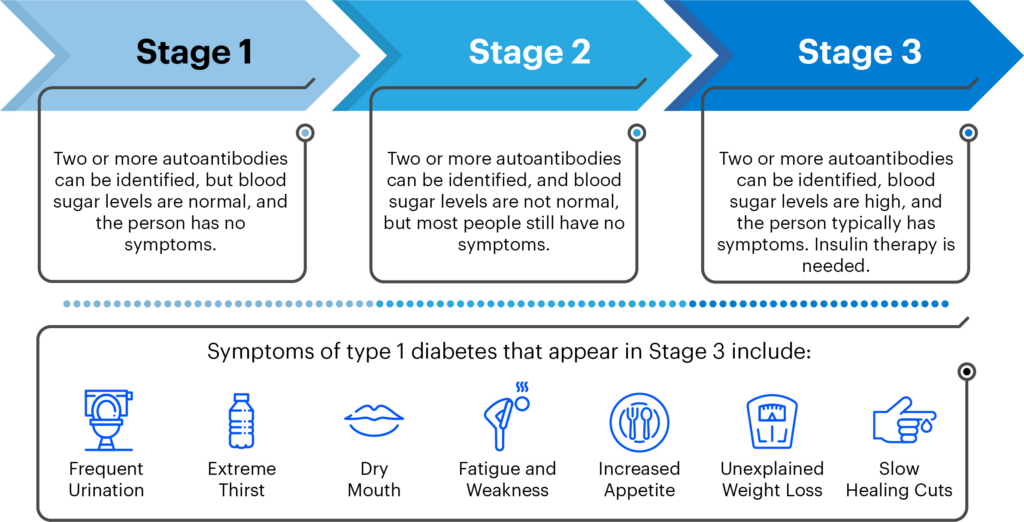
The prevailing medical wisdom used to be that T1D developed quickly, with a sudden onset of symptoms including thirst, hunger, increased urination, weight loss, and fatigue. Thanks to advances in screening and a better understanding of the human immune system, we now know that T1D does not develop suddenly but in fact the disease process usually starts long before insulin is required.  

Once the immune system begins to attack the insulin-producing cells in the pancreas, we can detect markers in the blood (autoantibodies) that tell us a person is at increased risk. This is because the disease is otherwise asymptomatic or silent earlier on.

T1D happens in 3 stages:

How to Detect T1D in 3 stages

Because most people do not have a family history of T1D, symptoms and a diagnosis often come out of the blue. In 25-45% of diagnoses in children in Canada, this unexpected diagnosis comes with DKA, a serious and life-threatening complication that can lead to death if not treated promptly. An important part of a screening program will be follow-up monitoring for those who screen positive for T1D autoantibodies, to lower the risk for life-threatening DKA at diagnosis and serious complications, and accelerate the evaluation of disease-modifying therapies that could delay or prevent the disease.  

A key goal of JDRF’s global research strategy is to support research that enables introduction of general population screening to identify high-risk individuals for early detection, reduce DKA at diagnosis, and accelerate the evaluation of disease-modifying therapies that could delay or prevent the disease. 

JDRF has numerous research studies examining the efficacy of potential disease-modifying therapies for T1D. But many of these therapies will work best during stage 1 and 2 T1D, which can only be identified via a screening program. Stopping T1D before it starts is the ultimate goal, and a universal screening program will be essential to prevent new diagnoses of this disease in the future.

Current Screening Options in Canada

Currently, only family members of people with T1D can be screened for T1D risk through the TrialNet research program. TrialNet is an international network of leaders in T1D research and clinical care with centers in the United States and internationally. 

We strongly encourage you to consult with your or your child’s physician for input as you make decisions about screening for T1D risk. Considering various sources of expert guidance and that from one’s own physician is the best way to make personal health choices.  

JDRF 2023 Innovation Grants

JDRF provides seed funding for highly innovative research with significant potential to accelerate the most promising type 1 diabetes (T1D) research in both cures and approaches to improve disease management. JDRF Innovation Grants address key challenges in T1D research and have the potential to generate ground-breaking discoveries.

JDRF is thrilled to announce that two Canadian researchers out of the University of British Columbia (UBC) have recently been awarded one-year Innovation Grants for their T1D studies in stem cell derived beta cells. 

A potential cure for T1D is to transplant islet cells (the cells responsible for producing insulin) from recently deceased donors. However, there aren’t enough donors to meet the demand for all people with T1D who could potentially benefit from this treatment. However – there is a potentially limitless supply of insulin secreting cells for transplantation if stem cells could be turned or ‘directed’ into beta cells that secrete insulin in response to glucose. A challenge to this approach is that, thus far, beta cells derived from stem cells do not produce as much insulin as naturally occurring, healthy beta cells.  Therefore, more research is needed to understand how we can derive stem cell-derived beta cells that match or even exceed the properties of naturally occurring beta cells.

The two new innovation grants will attempt to quantify (Dr. Hongshen Ma) and optimize (Dr. Dan Luciani) the insulin-producing capability of stem cell-derived beta cells, to get us closer to a product that can cure T1D.

While Dr. Ma and his team focus on identifying the properties of high achieving stem cell-derived beta cells, Dr. Luciani and his team are examining the role of the mitochondria in the insulin producing capacity of stem cell-derived beta cells.

Dr. Hongshen Ma (University of British Columbia)

Dr. Ma is working to discover why there is limited insulin-secretion capability of stem cell-derived beta cells, by examining the cells at an individual level. 

Recent research has indicated that not all beta cells within an islet are equal. Rather, different beta cells within an islet have different roles, and may produce different amounts of insulin.  One potential explanation for the limited insulin-secretion capability for stem cell-derived beta cells is that there are under and over-producers. It’s been theorized that when studied as a group, all the transplanted stem cells appear to produce little insulin relative to naturally occurring, healthy beta cells, but if looked at individually a subset of these cells are in fact producing much more insulin than the rest. Studying these differences is challenging, but cutting-edge approaches that allow single cell identification can reveal new insights about how islets function — and therefore how we can recreate them for cure therapies. 

To address this challenge, Dr. Ma and his team are developing a new technology to measure the insulin secretion capability of stem cell-derived beta cells at the single cell level. This technology will enable the discovery of which genes and proteins are responsible for the ‘higher insulin achieving’ subtype of stem cells. By further comparing these to cells extracted from donor islets, the researchers will also be able to assess how similar the stem cell-derived beta cells are to those found in a person without T1D. Together, this work will push the boundaries of the current understanding of how islets function so that scientists can develop more effective stem cell-derived therapies for T1D that may one day be available to everyone in need.

Dr. Dan Luciani (University of British Columbia)

Dr. Luciani’s project is rooted in the theory that the development of mature, fully functional, beta cells involves two-way communication between metabolism in mitochondria (essentially the powerhouse of a cell) and the appropriate regulation of specific genes. It is hypothesized that without the proper two-way communication, not all stem cell-derived beta cells mature in a way that allows them to produce insulin in response to glucose. 

Dr. Luciani’s team believes that this maturation process does not get fully activated when beta cells are created from stem cells in the lab, but that their mitochondria can be ‘jump-started’ to trigger a sequence of events that result in formation of beta cells capable of secreting insulin at greater levels, perhaps close to naturally occurring, healthy beta cells. 

To address this challenge, Dr. Luciani and his team will make use of two innovative approaches – first, they will extract fully-functional mitochondria and transplant them into the immature stem cell-derived beta cells. They will also experimentally control the processes by which mitochondria normally fuse with each other or split into smaller units to influence the resulting beta cells. The team will further use specific metabolic molecules, novel drugs, and genetic manipulations to alter the structure and function of the existing mitochondria in immature stem cell-derived beta cells. This work may provide an untapped opportunity to improve the function of beta cells derived from stem cells for transplantation.

Development of a genetic risk score for type 1 diabetes

The causes of type 1 diabetes (T1D) are complex and not fully understood. What is known is that there is a genetic component to developing T1D – but who is at greater risk?

JDRF Canada is pleased to announce a new JDRF grant to support Dr. Despoina Manousaki, pediatric endocrinologist and genetic epidemiologist at Sainte-Justine Hospital in Montreal, that will allow her and her team to explore how the genome of an individual can predict the risk of developing type 1 diabetes (T1D). The more we can understand about the genetic predisposition of T1D, the more effectively we can screen for this risk and develop therapies to halt or delay the progression of the disease.

Dr. Manousaki, a former JDRF postdoctoral fellow, leads a research program focused on the genetics of complex disease in childhood.

How do genetic risk scores for type 1 diabetes work?

Existing genetic risk scores for T1D were largely developed using data from White European populations, which differ substantially from Canada’s diverse population. In her new JDRF-funded project, Dr. Manousaki will develop a trans-ancestral polygenic risk score for T1D, in simpler terms – looking at how different ancestral backgrounds and genetics influence the risk of developing T1D. These newly developed risk scores will be used in research and clinical practice to assess T1D in a more equitable manner. Since the existing polygenic risk scores perform poorly in diverse ancestral populations (as they were developed primarily in White European populations), there is a need to diversify these scores, particularly for T1D-related genes which are known to vary between people of different ancestral backgrounds.

Dr. Manousaki will use machine learning approaches that employ computers and algorithms to examine large European genetic datasets while incorporating genetic information from African, Indian, Latino, South-East Asian and Chinese ancestries. This will create more precise individual risk estimates of developing T1D, an important step for informing T1D screening in a diverse population. By having a better understanding of who might develop T1D, clinical teams can better select candidates across diverse Canadian populations for clinical monitoring as well as T1D prevention trials.

With the recent FDA approval of teplizumab (brand name Tzield), the first ever disease-modifying therapy that can delay the onset of T1D, research like that performed by Dr. Manousaki and her team will ensure that new T1D therapies are tested and applied appropriately in the diverse Canadian T1D community.

Safe and immune cloaked stem cell-derived beta-cells: treatment for type 1 diabetes

A significant part of JDRF Canada’s research strategy is funding the most promising cure-based research for type 1 diabetes (T1D).

T1D is an autoimmune disease where the body destroys the cells in the pancreas responsible for making insulin. People with T1D must administer external sources of insulin, either through multiple daily injections, pump or pen in order to survive. Many cure-based research studies involve replacing these cells through transplantation, in the hopes that they will start producing insulin again.

Transplantation of donor cells could be a possible cure for type 1 diabetes

Transplantation of donor pancreatic islet tissue is a promising therapy; however, transplant therapy is limited due to shortage of transplantable islets (from deceased donors), limited durability of transplanted cells (cells that stop working or growing after transplantation), and the need for long-term immunosuppression therapy to prevent immune-based rejection of the transplanted cells, similar to organ transplants. Identifying alternative and more universal sources of transplantable beta cells is necessary to make this potential therapy available to larger numbers of people living T1D, and the Nagy lab is dedicated to achieving this.

How does it work?

In a brand-new JDRF funded project, Dr. Andras Nagy, senior investigator at the Lunenfeld–Tanenbaum Research Institute in Toronto, Canada, is testing the functionality of insulin-producing cells created from human stem cells. In collaboration with Dr. Timothy Kieffer (University of British Columbia), Dr. Nagy’s team will cultivate insulin-producing islet cells from an unlimited supply of human stem cells for a potentially unlimited cell therapy.

These cells will incorporate two gene-editing technologies previously developed and patented by the Nagy lab: (1)Dr. Nagy’s FailSafeTM technology is a gene-editing solution that employs an inducible kill-switch to rapidly eliminate dividing, potentially tumour-forming, cells, thereby eliminating the risk of tumours following transplantation of a stem cell-derived cell product. (2) Dr. Nagy and his colleagues have developed an “immunocloaking” strategy for the transplanted cells by modifying specific genes that allow these cells to remain hidden from an immune system attack.

These technologies will offer solutions to the safety concerns of cell therapy and the autoimmune challenge found in T1D, which could allow for stem cell transplants without the need for immunosuppression.

This is an exciting project that harnesses the most cutting-edge methods to develop a safe and effective cell therapy solution that may lead to a cure for T1D.

JDRF Canada will provide updates on this research as it becomes available, and when it moves to the clinical trials stage.

Exciting news: new Health Canada approved clinical trials

Health Canada has approved clinical trials that could lead the way for cell replacement therapy that does not require immune suppression in people with type 1 diabetes.

JDRF is the leading charitable funder of research into type 1 diabetes in Canada, with a focus on research that will help improve lives today, and lead to disease prevention and cures.

February, 2022 – As the leading charitable funder of type 1 diabetes (T1D) research in Canada, a key focus of JDRF’s strategy is investment in stem cell therapy research for potential T1D cures.

In November, 2021 Health Canada approved clinical trials for ViaCyte, a cell replacement company long supported by JDRF, and CRISPR Therapeutics for a VCTX210, a gene-edited cell replacement therapy for type 1 diabetes (T1D) that doesn’t require immunosuppression.

On February 2, 2022, the companies announced that the first patient was dosed in the phase I study, which will assess the therapy’s safety, tolerability, and immune evasion.

JDRF is very excited about the progress of this clinical trial, and will provide further updates as they become available

On November 16, 2021, ViaCyte, a cell replacement company long supported by JDRF, and CRISPR Therapeutics announced that they will begin clinical trials for a gene-edited cell replacement therapy for type 1 diabetes (T1D) by the end of the year in Canada.

What is cell replacement therapy?

A significant focus of cure-based T1D research is investigating stem cell-based therapy. Researchers look for ways to use stem cells as a renewable source of insulin-producing cells which, when transplanted, would replace the beta cells that are destroyed in a person with T1D, allowing them to produce insulin again. This would lessen or eliminate the amount of external insulin required by someone living with T1D (either by injection, pen, or pump) for months or even decades.

The biggest challenges to stem cell replacement therapy are identifying the appropriate stem cell source (i.e., pancreatic cells, or liver cells) and ensuring that they both function well and will not be rejected by the recipient’s immune system. Much like a transplanted organ – most stem cell replacement therapies require immunosuppressing medications to prevent rejection.

What is different about the ViaCyte and CRISPR therapy?

By the end of the year, Viacyte will start a clinical trial of VCTX210, a gene-edited stem cell replacement therapy for T1D. Combining ViaCyte’s stem cell expertise with CRISPR Therapeutics’ pre-eminent gene-editing platform offers significant potential in the development of a cell replacement therapy that does not require immune suppression.

The phase I clinical trial will begin this year in Canada, and will evaluate the safety, efficacy, and immune evasiveness of the therapy, and will be the first time a gene-edited cell replacement therapy will be tested in people with T1D.

ViaCyte has previously demonstrated that their stem cell-derived beta cells, (which JDRF globally funded the development of), make insulin when transplanted into people with T1D. Now, CRISPR has applied their gene-editing technology to make these cells immune-evasive – meaning that they should not require immunosuppression to prevent rejection – a huge development in making the therapy more universally accessible to people with T1D.

What is JDRF’s role?

JDRF globally has been a long-time and significant supporter of ViaCyte, supporting the company through research funding, including funding 15 years ago (when ViaCyte was called CyThera) that underwrote development of the proprietary line of precursor stem cells used in their treatment.

This clinical trial is one of several potential beta cell replacement cures therapies JDRF is currently funding or supporting.

What does this mean for Canadians with T1D?

JDRF will be closely monitoring the results of the phase 1 clinical trial and will report back on results as they become available.

JDRF-CIHR Partnership to Defeat Diabetes Grants Now Announced

The pace of type 1 diabetes (T1D) research is moving faster than ever before. 

In November 2021 to mark November’s National Diabetes Awareness Month, JDRF announced a new investment of $7 million to support four Canadian research teams as part of the JDRF-CIHR Partnership to Defeat Diabetes, which will help to accelerate development of stem cell-based therapies for T1D as well as improve pediatric diabetes research and quality improvement across Canada, and our understanding of variation in human insulin production. 

This is part of the results of the Team Grants in Diabetes Mechanisms and Translational Solutions competition, an investment of $20M in 10 research projects. Diabetes Canada, Kidney Foundation of Canada, and the FRQS have also received funding as part of this competition, as all work together to improve health outcomes for Canadians. 

JDRF is pleased to share the summaries of all four research grants: 

Designing stem cell-derived islets for diabetes therapy

Dr. Timothy Kieffer (University of British Columbia) Nika Shakiba, (University of British Columbia), Dr. Elizabeth Rideout, (University of British Columbia; CIHR Sex and Gender Science), Dr. Corinne Hoesli, (McGill University), Dr. Christopher Moraes (McGill University) 

People with type 1 diabetes lack the islet cells that release the hormone insulin. Scientists at the University of Alberta made breakthrough improvements in transplanting clusters of insulin-producing islet cells. The procedure is quick, and many transplant recipients can reduce or even eliminate insulin injections. Unfortunately, the only current source of islets for transplant is recently deceased donors and only a tiny fraction of those in need can receive the procedure.  

Over the past several years, there have been remarkable breakthroughs in unravelling the process by which islet cells develop naturally in the body. As a result, it is now possible to replicate many steps of this process in the laboratory with cultured stem cells, culminating in insulin-producing cells. Kieffer and his team are aiming to significantly improve upon the manufacturing of the islet cells to obtain more robust insulin delivery, with a focus on generating an optimized process to mass-produce stem cell-derived islet cells that will form the basis for new clinical trials in patients with type 1 diabetes. 

A first-in-human trial of autologous induced pluripotent stem cells (ipsc)-derived islets: Developing a personalized diabetes therapy

Dr. James Shapiro, (University of Alberta), Dr. Timothy Kieffer, (University of British Columbia),
Dr. Gregory Korbutt, (University of Alberta), Dr. Patrick MacDonald, (University of Alberta), Dr. Andrew Pepper, (University of Alberta), Dr. Blaire Anderson, (University of Alberta), Dr. Anna Lam, (University of Alberta), Dr. Peter Senior, (University of Alberta), Dr. Khaled Dajani, (University of Alberta) 

In type 1 Diabetes (T1D, ~10%), the B-cells are destroyed by one’s own immune system. In type 2 Diabetes (T2D, ~90%), the body becomes more resistant to insulin, increasing the demand and eventually leading to B-cell damage. Shapiro and his team will develop a stem cell-based therapy to replace or supplement damaged B-cells in people with all types of diabetes.  

They propose to manufacture new B-like cells from patients’ own blood cells so that they will be accepted by the immune system and no/minimal anti-rejection drugs are needed. In this project, they will conduct a first-in-human trial to implant these cells under the patient’s skin and evaluate their safety and preliminary efficacy. 

Being able to transplant an unlimited supply of self-derived islet cells without immunosuppressants is a novel approach to treat all forms of diabetes.

A deep phenotyping network for understanding human islet variation in health and diabetes 

Dr. Patrick MacDonald, Nominated Principal Investigator: Canada Research Chair; University of Alberta, along with his team: Dr. James D. Johnson, (University of British Columbia) Dr. Jennifer Bruin, (Carleton University) and Dr. Jianguo (Jeff) Xia, (McGill University). 

Insulin is the primary hormone responsible for controlling blood sugar levels. It is produced by the pancreatic islets of Langerhans, rises after a meal to promote energy storage, and falls during fasting to allow energy mobilization. The levels of insulin in the blood vary tremendously amongst people. Nutrition, age, sex, genetics, and environmental exposures are all important factors likely to impact insulin levels. However, the underlying mechanisms by which these factors affect islet insulin production at the cellular level are not clear.   

This team seeks to understand the variability in human islet function in relation to genetic and environmental impacts on diabetes risk and to identify mechanisms of islet dysfunction in diabetes. To do this they will take advantage of extensive data on the molecular, cellular, and physiological function of islets from human organ donors. They will also produce tools and resources so that other researchers can explore this data to answer their own questions about islet dysfunction in diabetes.  

Building CAPACIty for pediatric diabetes research and quality improvement across Canada  

Dr. Shazhan Amed, Nominated Principal Investigator: B.C Children’s Hospital, along with her team: 

Dr. Meranda Nakhla, (Montreal Children’s Hospital; McGill University), Dr. Julia von Oettingen, (Montreal Children’s Hospital; McGill University) and Dr. Ian Zenlea, (Trillium Health Partners; University of Toronto). 

Although there have been many advances in diabetes care since insulin was discovered 100 years ago, youth with diabetes continue to have a higher risk of other health problems, a lower quality of life, and a shorter life span than their peers without diabetes. This health gap is likely in part due to suboptimal access to and delivery of their diabetes care, which is worse in disadvantaged populations across Canada. This project will develop strategies to address these gaps.   

The CAnadian PediAtric diabetes ConsortIum (CAPACIty) is a network of 15 childhood diabetes centers from across Canada. They are partnering with patients/families and health care professionals to jointly design and develop a Canada-wide childhood diabetes registry and research platform. The registry will enable them to improve diabetes care and health outcomes for Canadian youth through comparison of diabetes care quality and outcomes between Canadian diabetes centers, quality improvement initiatives, patient-informed research initiatives across Canada, and successful advocacy work.   

They anticipate that the CAPACIty registry will not only lead to better health outcomes but also serve as a powerful tool for governments and decision-makers to implement policy decisions that are driven by our data. Lastly, the patient advisory board will ensure better representation of youth with diabetes and their parents among provincial and national associations that advocate for people living with diabetes. 

As we celebrate the centenary of the first successful insulin shot in 2022, a groundbreaking achievement that saved millions of lives, we recognize the need to continue investing in research that will move us beyond insulin treatment towards a cure.  

These new grants are an important step in that direction. 

To read more about all the JDRF-CIHR Partnership to Defeat Diabetes: www.breakthrought1d.ca/research/jdrf-cihr-funded-projects/ 

Exciting update in Sernova’s type 1 diabetes (T1D) trial

Principal researcher confirms trial participants with a history of hypoglycemia unawareness are now insulin independent.

Funding cell replacement therapies research is one of JDRF’s most critical undertakings globally, in its efforts to support the most promising cure-based research into type 1 diabetes (T1D).  

On January 10, 2022, Sernova Corp. provided a progress update on its Phase 1/2 T1D clinical trial, a JDRF-funded clinical trial of its cell replacement therapy. The findings were presented by Dr. Piotr Witkowski, the clinical trial’s Principal Investigator at the University of Chicago.

Sernova is a clinical-stage regenerative medicine company and has continued to demonstrate promising results for its Cell Pouch System™. When transplanted with insulin-producing islets, this system has consistently demonstrated in ongoing trials that it can produce insulin in people T1D, and participants maintain more consistent blood sugar levels. Additionally, it has demonstrated ongoing safety and tolerability of the system. In Sernova’s current clinical trial, patients must take immunosuppressive drugs to prevent rejection of the implanted cells.

Sernova’s approach for T1D involves transplanting purified islet cells (the cells in the pancreas that produce insulin and that are destroyed in people with T1D) from organ donors into the Cell Pouch™, an implantable medical device that allows these cells to survive long term and produce insulin. This is a cell replacement therapy that has the potential to be a T1D cure.

The objective of Sernova’s Phase 1/2 clinical trial is to assess the safety, tolerability and efficacy the Cell Pouch™ transplanted with insulin-producing islets in trial participants with T1D who have a history of hypoglycemia unawareness and severe hypoglycemic events.

To be in the study, participants must meet stringent eligibility criteria including, but not limited to, long-standing T1D, recent episodes of hypoglycemic unawareness and an absence of glucose-stimulated C-peptide detectable in their bloodstream (a biomarker that demonstrates the body is making its own insulin).

Hypoglycemia unawareness is a person’s inability to recognize the symptoms of low blood sugar before they become severe or even fatal. It typically occurs when blood glucose levels are below 3.0 mmol/L and is estimated to affect approximately 15% of people with T1D.

Highlights from the study include:

  • Maintained and ongoing safety and tolerability of the Cell Pouch™
  • Islet transplantation to the Cell Pouch™ resulted in the establishment of new, measurable islet function, documented by detectable levels of stimulated C-peptide in the first three participants who completed the course of transplants.
  • A supplemental, single intraportal islet transplant was enough for the first two participants to achieve and maintain sustained ongoing insulin independence and freedom from severe hypoglycemic events for over 21 and 2 months, respectively.
  • The third transplanted participant who recently completed their course of Cell Pouch™ transplants and a supplemental intraportal islet infusion, saw improvements in glucose control, near-normal levels of C-peptide, an absence of severe hypoglycemic events and reductions in daily insulin use.
  • Three additional participants are progressing through the study.

Sernova’s Cell Pouch™ System was created with the goal of one day treating people with T1D and other chronic diseases using stem cell-derived technologies, that will not require immunosuppression. Sernova is partnering with other companies to advance the Cell Pouch™ system to testing using a stem cell-derived source, as well as approaches that will reduce or eliminate the need for immunosuppression.

To date, between our partner organizations JDRF has invested more than $140 million USD in cell-replacement therapy research for T1D. As we celebrate the 100th anniversary in 2022 of the first successful insulin injection, this is another example of Canadian excellence in diabetes research that is accelerating us towards cures.

Celebrating Leonard Thompson Day

January 23rd marks the 100th Anniversary of the first successful insulin injection

JDRF’s primary goal is to cure type 1 diabetes (T1D) through research – as quickly as possible. To support people with T1D while cure research is advancing, we also fund ground-breaking research that seeks to make life with T1D easier, safer and healthier. With the discovery of insulin 100 years ago, JDRF is committed to funding the most promising research to move us beyond this treatment and toward cures.

1921

Before insulin treatment, a diagnosis of type 1 diabetes meant inevitable death. T1D destroys the beta cells in the pancreas that make insulin, without which, the body cannot maintain healthy blood sugar levels.

In 1921, Frederick Banting and Charles Best discovered that the pancreas produced the insulin hormone under the directorship of John Macleod at the University of Toronto. With the help of James Collip, they purified a synthetic version of insulin and produced the first real treatment for diabetes. To this day, it remains one of the most important scientific breakthroughs in the medical field, often called ‘Canada’s gift to the world’.

January 11, 1922

On this date, fourteen-year-old Leonard Thompson, a teenage boy who was dying from T1D complications, became the first person to receive an insulin injection. But instead of lowering his blood sugar, it caused an allergic reaction. Leonard’s doctors went back to the lab, where they worked nearly around the clock to improve the formulation. 

January 23, 1922

Almost two weeks later, they returned to Leonard’s bed with a new syringe of insulin. With this version, Leonard’s symptoms began to disappear, and he regained his health. He would live another 13 years. The discovery of insulin, along with Leonard’s willingness to try this new treatment meant the death sentence that was T1D could be lifted, and people around the world could use insulin to manage their diabetes.

The importance of clinical trials

Research is how insulin was discovered and it is how we will find the next generation of therapies for T1D, and eventually a cure.

And clinical trials are an essential component of medical research and development. While Leonard’s receiving the first insulin to human injection was not known as a “clinical trial,” at the time, his participation allowed his doctors to rework and refine the formula that would make it a successful treatment for diabetes for over 100 years. In modern terms, Leonard was the first human participant in a clinical trial to test the impact of insulin on T1D.

This demonstrates the far-reaching impact of clinical trials. These studies can help bring new, better treatments to market that will impact the lives of millions. Thanks to Leonard Thompson, the updated version of insulin became a true breakthrough in diabetes care.

Funding cell replacement therapies research is one of JDRF’s most critical undertakings globally, and between our partner organizations we have invested more $140 million USD to date.

JDRF funds stem cell derived beta cell replacement trials that are ongoing right now, like those at ViaCyte, Vertex and Sernova and from here we may witness the research that leads to a T1D cure.

Participating in clinical trials

JDRF is funding many clinical trials, and one of the biggest challenges is finding volunteers to take part in studies – and it’s often because they simply didn’t know they could. It is also important to have a diverse group of participants who represent the Canadian T1D community, so that potential therapies and treatments can be tested for efficacy against the larger group who will be using them. When someone participates in a clinical trial, they help all people living with T1D, by enabling research towards better health outcomes and cures.

Choosing to participate in a clinical trial is a very personal decision. Early access to promising new treatment can be an enormous benefit. Others have found that by participating in a clinical trial, they learned more about their health or T1D management. And it can be motivating to know you are contributing to helping accelerate research that can improve the lives of people living not only with T1D, but other chronic conditions as well.

To learn more about Canadian clinical trials, and to find studies near you: https://breakthrought1d.ca/research/clinical-trials/

One person can make a difference – watch Tilla’s story of participating in clinical trials after her T1D diagnosis

On January 11, 1922, Leonard Thompson took a leap of faith. And when that first injection did not work, he took another step forward and tried again. From the bravery of one teenage boy, came millions of people whose lives have been saved by insulin. And every year across the globe, people living with T1D celebrate their ‘insulin anniversary’ while waiting for the breakthrough that will move us beyond insulin and towards a cure.

Every person who participates in a T1D clinical trial study helps us get closer to moving therapies from the lab to the market. We recognize too their courage and are so grateful for their help in accelerating the research that will one day mean a world free from diabetes.

Donate | Donnez